9/25 is now Dolly Parton Day, featuring her greatest film
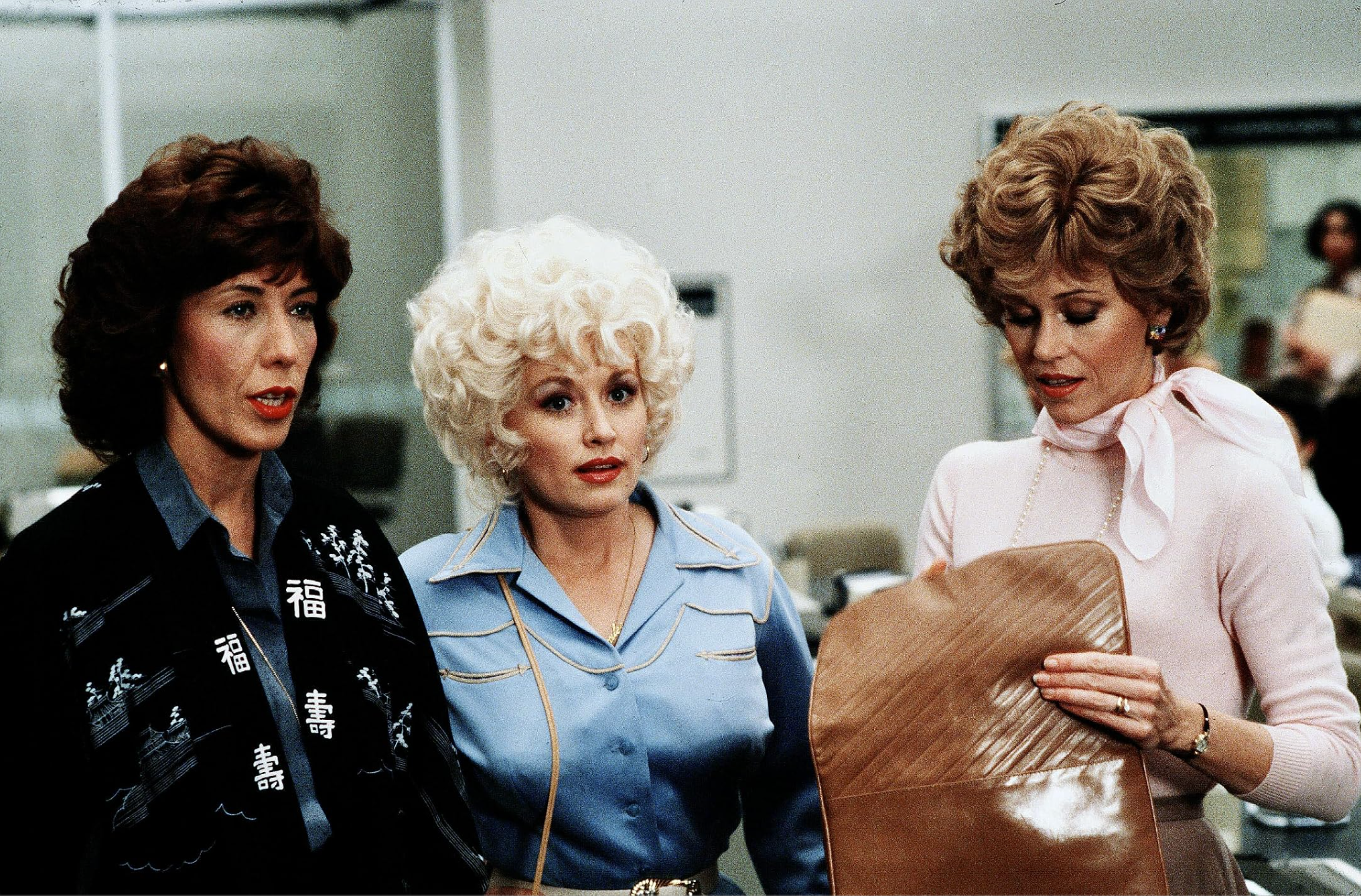
Last month the world said goodbye to Dolly Parton, a woman with as valid a claim as any to the title of Most Beloved Public Figure on Earth (she blew away the competition in a survey in March). In addition to her seven-decade recording career, her expansive humanitarian work, and her renowned decency as a human being, Parton made her mark on Hollywood with a successful second career as an actress. On Friday, the Somerville Theatre presents a special screening of Dolly’s greatest film, “9 to 5” (1980), naturally, on 9/25, with a ticket price of exactly $9.25. “9 to 5” casts Parton alongside Jane Fonda and Lily Tomlin as a trio of overworked secretaries who mistakenly believe they’ve accidentally killed their “sexist, egotistical, lying, hypocritical bigot” of a boss, then hold him hostage once they realize he’s still alive. It’s one of the most beloved and anarchic comedies of the ‘80s, thanks in no small part to both Parton’s effervescent performance and her deathless title song. It seems a safe bet that 9/25 will be designated an unofficial holiday for years to come.
Read more Timmins hits 55 (years) teaching drivers ed in Cambridge
This week the Brattle Theatre partners once again with Il Cinema Ritrovato, a Bolognese film festival dedicated to screening the latest restorations of classic films, for another round of Cinephile Heaven. Highlights of this year’s heavenly offerings include a new director’s cut of Charles Burnett’s “My Brother’s Wedding” (1985, screening Friday and Saturday), which never received an official theatrical release in the US following a botched film festival premiere; a brand new 4k print of Guy Maddin’s gonzo expressionist nightmare comedy “Careful” (1992, Sunday and Tuesday); a meticulously restored edition of F.W. Murnau’s silent masterpiece “Sunrise: A Song of Two Humans” (1927, Tuesday), complete with live musical accompaniment; and far more favorites and hidden gems alike than can be squeezed into a single paragraph. For a complete lineup, check out the Brattle’s website — or simply camp out at the Brattle for the entire week. You really can’t go wrong.
On Saturday, the Harvard Film Archive’s Undergraduate Cinematheque tribute to nostalgia continues with one of the defining cinematic statements on the subject. In “Amarcord” (1973), director Federico Fellini turns his penchant for thinly veiled autobiography toward his childhood in the Italian village of Rimini. Fellini populates his film with characters and anecdotes Fellini recalled from his youth, but “Amarcord” is just as interested in the act of remembering itself. Everything in the film is exaggerated to surreal, occasionally grotesque proportions — as if it were seen through the eyes of a child, then processed verbatim through the mind of an adult. “Amarcord” is perhaps the greatest synthesis of Fellini’s obsessions, humor and flair for unforgettable visuals, and an essential text in any discussion of nostalgia.
Read more Home style Afghan food in a regal setting
It is a common misconception (reinforced by decades of corporate propaganda) that the first animated feature film was “Snow White and the Seven Dwarfs” (1937). In fact, Walt Disney was beaten to the punch by more than a decade by Lotte Reininger, who receives her due with a pair of screenings at the HFA. Born in Berlin in 1899, Reininger was a master of the silhouette, first creating paper shadow puppets, then adapting her creations to the nascent medium of cinematic animation. Reininger’s “The Adventures of Prince Achmed” (1926), which screens on hand-tinted 35mm Sunday with live musical accompaniment by Robert Humphreville, is the true holder of the title, and stands as a staggering work of invention and artistry. It’s followed on Monday with a program of rarely screened Lotte Reininger Short Films, a delightful assortment of miniature fairy tales rendered in Reininger’s distinct style. A century after her defining work, Lotte Reininger is finally being recognized as a true pioneer of the art form.
Back at the Somerville, this week’s installment of Cult Cinema Tuesdays features arguably the ultimate midnight movie, screening at the much more bedtime-friendly hour of 7:30 p.m. John Waters’ “Pink Flamingos” (1972) was originally sold as “An exercise in poor taste,” and while it certainly lives up (or down) to its tagline, it has a lot more going for it than shock value. Babs Johnson (drag legend Divine, in her most iconic role) relishes her title as “The Filthiest Person Alive,” but she finds her crown challenged by human-trafficking yuppies Connie and Raymond Marble (Waters regulars Mink Stole and David Lochary). The plot is mostly a framework for whatever disgusting acts Waters and his accomplices could dream up, including a chicken orgy, a lip-syncing anus, and, most notoriously, Divine eating real dog feces on camera. But if you can get past the gross-out humor, there’s an infectious, demented cheerfulness to the proceedings which makes it difficult to fully dislike. Waters and his found family of Baltimore-area weirdos were clearly having the time of their lives making their sick little movie, and that enthusiasm radiates off every frame. All together now: “Filth is my politics! Filth is my life!”
Read more Healthpeak gets ok from Planning Board, moves to next hurdle