Cambridge councillors take a stand on Cuba but not foreign policy, mayoral election
Monday’s city council meeting saw a close vote in favor of asking the federal government to end its economic blockade of Cuba. But councillors disagreed on whether to offer future direction on United States foreign policy and delayed a vote on asking the electorate to consider changing how Cambridge elects mayors.
Read more Films on relationships, one remarkable, one nightmarish
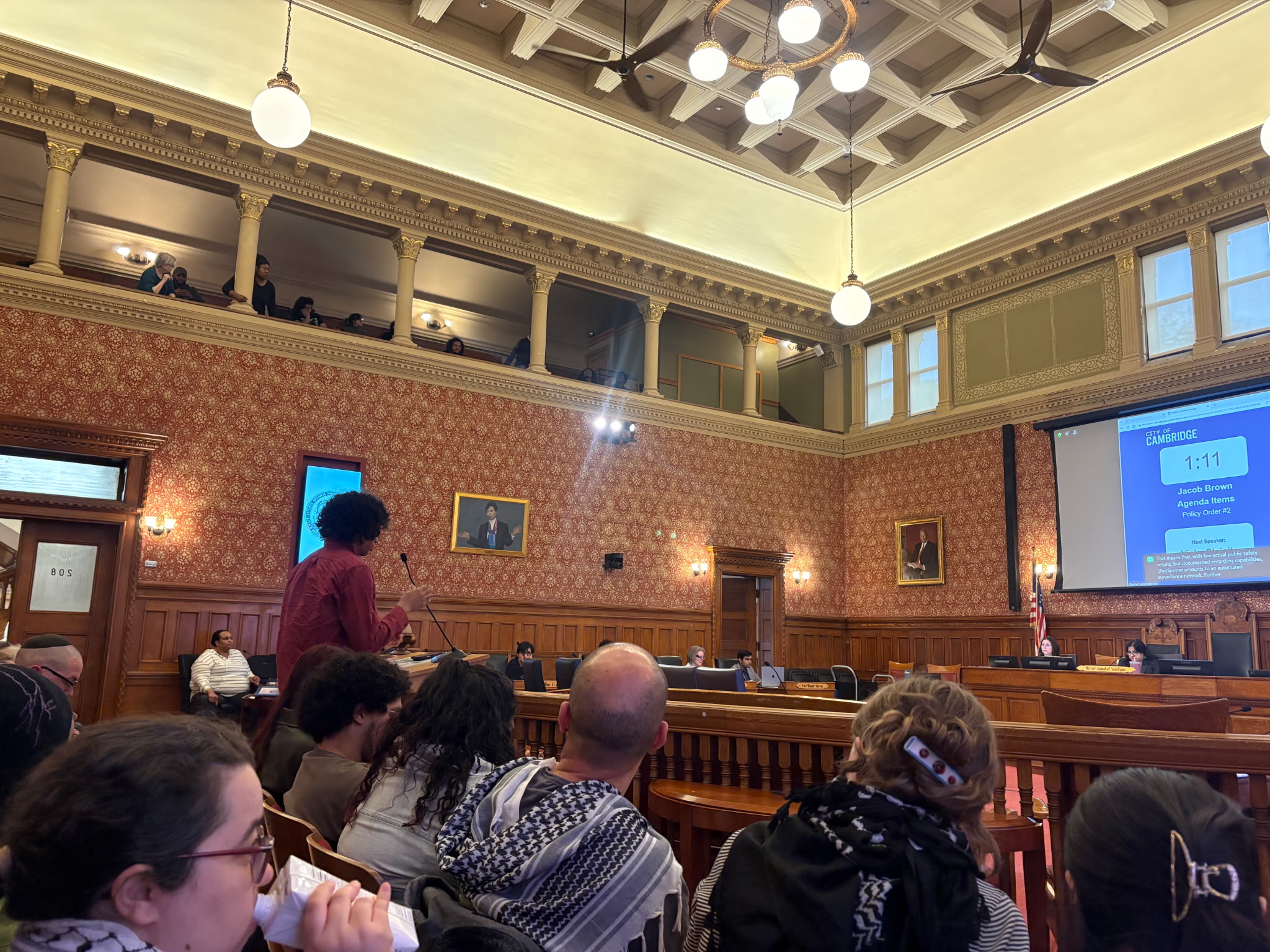
Last week, more than two dozen public commenters came to the meeting in support of the policy order calling for an end to the threats of tariffs on countries that could supply oil to Cuba, which has amounted to a massive energy crisis on the island. Councillor Patty Nolan used her charter right to move it from last week’s the agenda to this week’s. Many speakers returned to urge council to pass the legislation on Cuba (listed as “Charter Right 1” in the proceedings). Ultimately, it obliged, with five councillors voting yes and four voting present (see table). Councillors were also asked to reject Policy Order 5, ordering two council committees to hold a joint session discussing how to address future foreign policy issues.
Some councillors spoke in favor of exploring restrictions on foreign policy debates for the sake of effective meetings. Those opposed thought it appropriate for a progressive city like Cambridge and a part of the body’s tradition of standing up for human rights.
Here’s how the votes broke down:
“Last week, I came here talking about how proud I was of the legacy of our city, and I left ashamed,” said Cambridge resident Jacob Augenstern. “We were told [we were] taking too much time on [Charter Right 1], and here we are spending twice as much time on it,” he said.
Many invoked the legacy of Caroline Hunter, a longtime Cambridge resident known for her anti-apartheid activism. A photograph of her hangs in the hallway outside city council chambers. In the 1970s, Hunter co-founded the Polaroid Revolutionary Workers Movement after discovering the then Cambridge-based company she worked for was supplying the film for passbook photos used to identify Black South Africans. Polaroid eventually banned all sales to South Africa as a result. Hunter went on to teach in Cambridge Public Schools for three decades and served on the School Committee from 2022-2025.
Debate over foreign affairs
“I don’t understand how we speak out of both corners of our mouth on city council. On one side, we want to praise the good trouble of yesterday’s activists … and at the same time try to silence any public comment or democratic function or any kind of good trouble that could come after,” said Cambridge resident Malick Abban.
In her remarks, Councillor Patty Nolan clarified the immediate impact of Policy Order 5, calling accusations that it was an attempt to silence debate “beyond hypocrisy.”
“All it does is ask for a conversation about how the council might discuss foreign policy issues. It doesn’t say that we won’t discuss them. It doesn’t even say we won’t continue to discuss them on Monday night regular meetings,” she said.
Councillor E. Denise Simmons, who co-sponsored Nolan’s policy order and also voted against Charter Right 1, echoed concerns about of the use of council time. “Our community is made up of people with deep ties all over the world, and when there is suffering, conflict, or injustice elsewhere, that pain is often felt very personally right here in Cambridge,” Simmons said. “But as a governing body, we also have a responsibility to be thoughtful about how the Cambridge City Council uses its regular meeting time.”
Councillor Ayah Al-Zubi, who co-sponsored Charter Right 1, disagreed, saying “We are representatives, so we work to bring in and elevate voices. When I see veteran councillors walking back a legacy of standing up for human rights, that’s chilling.”
Simmons pointed out that council’s approach to issues outside its direct authority have always been somewhat arbitrary.
“Why didn’t we bring up the Voting Rights Act?” Simmons said, in reference to a recent U.S. Supreme Court ruling severely limiting how states create or keep congressional districts with a majority of people of color. “No one stood up and said a single word, not even myself. Why? Because I believe in thinking globally and acting locally.”
Read more Why Cambridge needs social housing
Vice Mayor Burhan Azeem was one of two councillors to vote for both measures before the council.
“I want to be clear that it’s not me believing that we shouldn’t discuss foreign policy issues,” said Azeem. “There’s a meaningful way to engage the community to bring people along, and I feel like the current structure isn’t properly working.”
Cambridge mayoral elections
Councillors used their charter right to boot six items on their plate to next week’s agenda. One of the most impactful is a policy order to explore options that would allow Cambridge voters to directly elect their mayor.
Under the city’s current charter, councillors select a mayor amongst themselves. A councillor needs a total of five votes to take office. The vote is the first order of business for council at the start of a new term, often leading to behind-the-scenes jockeying and frustration between election and inauguration day.
Multiple councillors have spoken about the unpleasantness of the process.
“We don’t know who the mayor is going to be, and that’s just not a great way to start the term, right?” said Councillor Jivan Sobrinho-Wheeler, who is the lead sponsor of the policy order. “Having hurt feelings, leaving that process is just not a great way to start.” He called for letting voters choose.
The policy order is co-sponsored by three councillors who campaigned to become mayor at the beginning of this term: Nolan, Marc McGovern (who served as mayor from 2018-2019) and current mayor Sumbul Siddiqui.
Any change to the city’s charter would need to be voted on by Cambridge residents. They did just that in November, after the city completed its first charter review in 80 years. A charter review must happen every decade, but changes to the charter can be made outside of that process.
Sobrinho-Wheeler said changing to a system where mayors are directly elected was brought up during last year’s charter review process, but “needed more time for discussion.”
McGovern weighed in on what the policy order doesn’t do. “This order is asking for a discussion on options for allowing Cambridge voters to directly elect a city mayor,” McGovern said. “It does not say that we’re gonna do it. It does not say how we’re gonna do it, and it certainly doesn’t say anything about changing the structure of city government and moving away from a strong city manager.”
Speaking in opposition to the policy order, Councillor Cathie Zusy said “it seems like we already spent a lot of time talking about this last year. I thought we were good for 10 years and maybe we should be having this conversation in nine years … to open this up again is just a distraction.”
In the end, Simmons exercised her charter right, saying more discussion was needed about the charter review process.
Read more Parents push Murphy for answers on 158 Spring Street, Ahern field
