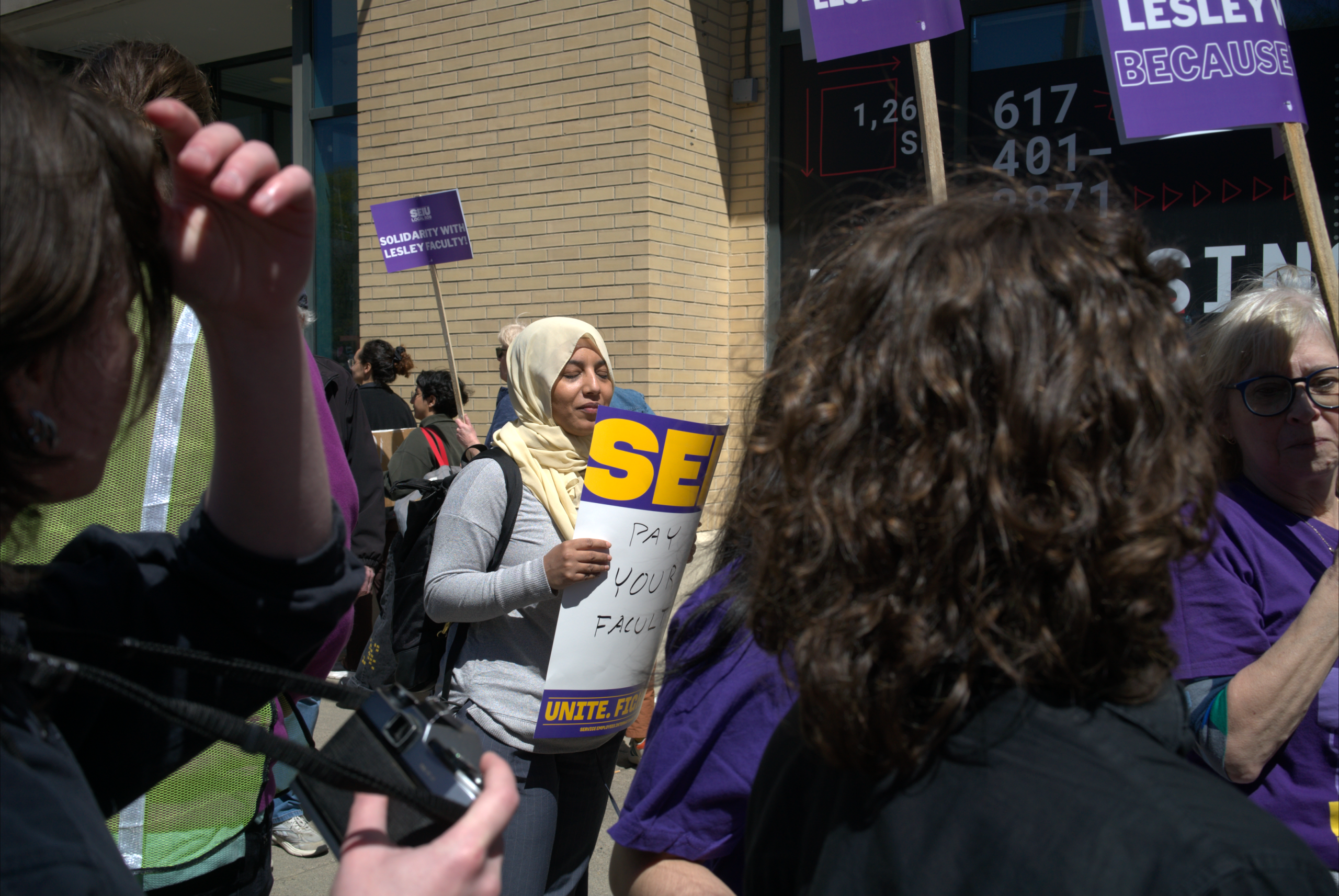
Lesley University faculty launch two-day strike
Unionized core faculty members at Lesley University started a two-day strike Tuesday at 1 p.m., after nearly two years of unsuccessful negotiations.
Read more City council sees one way forward for Garden Street
A bargaining committee representing 82 core faculty members failed to reach an agreement with administrators on Monday. The committee spent 15 hours Monday trying to reach an agreement with administrators, only ending their bargaining meeting at 3:00 a.m. Tuesday.
“What I’m feeling right now is a sense of pride and excitement,” said Kelvin Ramirez, associate professor in Lesley’s expressive therapies division, who spoke with Cambridge Day on Tuesday. “Our faculty is speaking in a clear, unified voice … I’m excited to really get to a resolution and secure a strong contract for the faculty.”
Lesley sent a note to students saying that classes would not be canceled. “We understand that you may have received conflicting messages about whether your scheduled classes will or will not be held. To be clear, classes will be held while some faculty are on strike today (Tuesday) and tomorrow (Wednesday).”
However, students contacted said that only some classes were held. Jay Rowell, a junior at Lesley, said they had class today but it was a class taught by the dean of students, an administrator.
A strike first appeared on the table on April 16, when an overwhelming majority of the faculty members, represented by SEIU Local 509, voted to authorize it. Faculty members are demanding fair compensation, manageable workloads and a successorship clause that would ensure their union contract remains in place should Lesley close or be acquired.
The strike comes less than a week after Janet Steinmayer announced her departure from her position as Lesley University president. Her tenure, which officially ends June 30, has come with much controversy over her handling of a $10 million budget gap – this saw some smaller programs eliminated and faculty and staff laid off. Since taking office in 2019, faculty members have passed three votes of no confidence against Steinmayer.
Ramirez said a two-day strike was chosen to illustrate the faculty’s level of commitment.
“We don’t want to get into a situation where both parties are frustrated with each other,” Ramirez said. “I think that there is some level of desire to resolve this for the benefit of the university and while there’s still some distance in wages and manageable workload, I’m confident that this two-day strike will demonstrate our commitment to the administration.”
Read more City of Cambridge proposes first billion-dollar budget
SEIU Local 509 has also filed five unfair labor practice charges with the National Labor Relations Board, asserting violations of the National Labor Relations Act, which requires employers to bargain in good faith with unions and protects workplace democracy for employees at private-sector workplaces. The five charges were filed because Lesley has made numerous changes to working conditions without bargaining, according to Natalia Berthet Garcia, communications director of SEIU Local 509. The charges include a unilateral reduction of administrative units, eliminated rank titles for temporary core faculty and changes to the cap of students enrolled in individual courses, Berthet Garcia said.
Local and state elected officials, including Mayor Sumbul Siddiqui, State Sen. Patricia Jehlen, and State Representatives Marjorie Decker, Mike Connolly, Steve Owens and Dan Ryan signed and sent a letter to Lesley administrators Tuesday, urging them to “reach a fair and equitable resolution to their ongoing contract negotiations” and “address their current salary, workload, and job security challenges,” according to a press release.
Ramirez said that while it is hard to anticipate how administrators will respond to the strike, he’s hopeful that he and his colleagues can reach a fair contract so long as administrators are willing to agree.
“It’s up to Lesley’s administration to come to the table and meet our demands,” he said. “We’re not asking for anything that’s unreasonable.”
Other Cambridge campuses are also facing labor unrest. Harvard’s graduate students went on strike last Tuesday, an effort that is ongoing. The Harvard Crimson reported Tuesday that Harvard had made an offer to increase wages and add certain benefits. Harvard’s offer does not address increased security for non-citizen workers, a key demand by the Union.
“People are fighting for a contract because they face challenges regarding research funding, immigration security, and even basic workplace protections,” said Evan MacKay, former president of the HGSU union who is running against Decker for state representative. MacKay added “I’ve had colleagues turn down major talks abroad, even chances to see family, because they weren’t sure they’d be let back into the country. We need Harvard to commit to standing up to protect our students and workers in these cases.”
At MIT, graduate students will see their contract expire at the end of May. Negotiations for a new contract started Thursday. MIT students, who are part of United Electrical Workers Local 256 – MIT Graduate Student Union, are seeking higher wages, funding security, and expanded protections for international workers. The president of MIT’s union, Lauren Chua, a PhD candidate, said in a statement that MIT’s leadership had been slow to start negotiations. “They are sending us the message that they don’t care if we don’t get a raise in June, they don’t care if international grad workers don’t have adequate protections in this political climate,” Chua said.
Read more Harvard scientist working on technology to find life in space
Jennifer Chen and Jane Petersen contributed to this story.