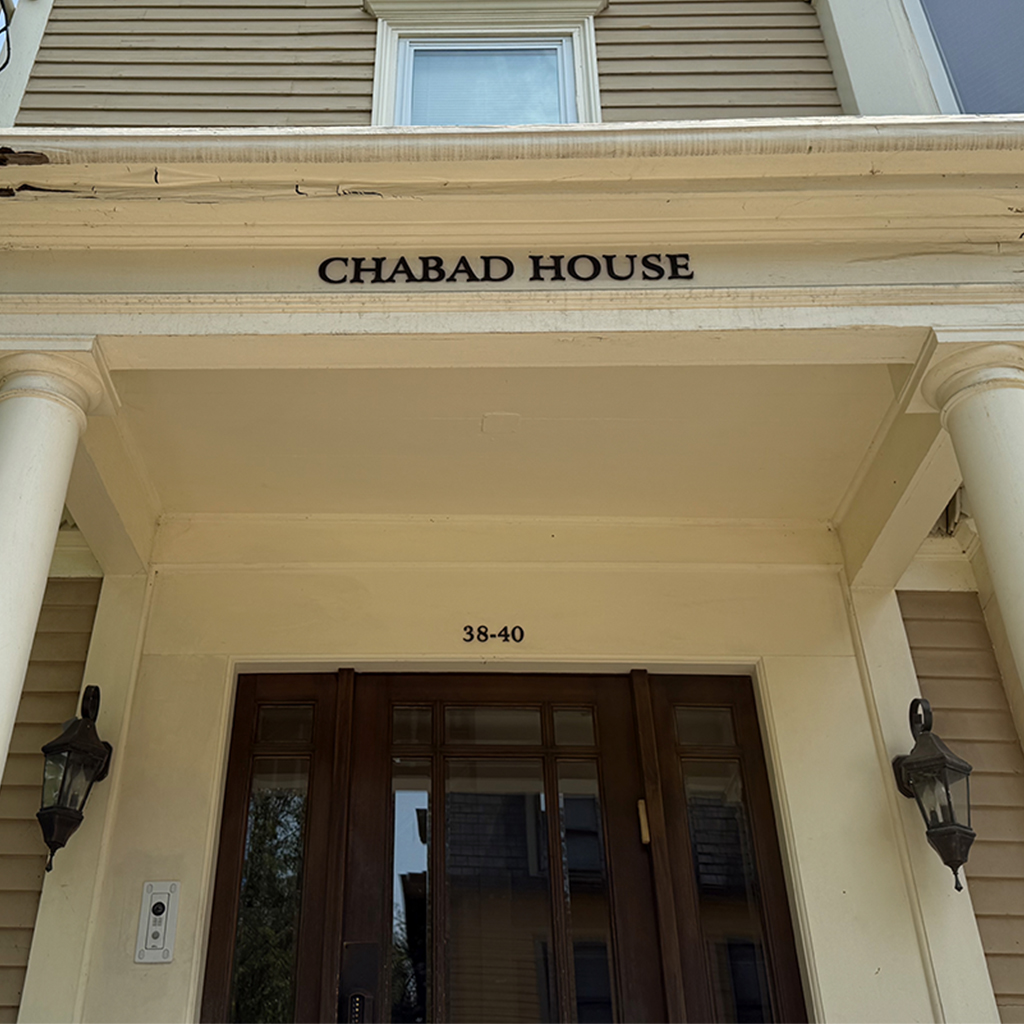
City promises Lubavitch “its best efforts” to help fend off neighbors
The city has agreed to “use its best efforts” to help an orthodox Jewish center prevail in court if neighbors try to stop or delay the religious group’s expansion plan on Banks St. The project, which will take two years to build, according to a plan filed with the city, will put a massive five-story, 70-foot-high concrete building among mostly traditional three-story homes.
Read more Seeking efficiency, Cambridge city councillors set limits
The commitment to help Lubavitch of Cambridge is part of a legal settlement with Lubavitch, the result of a suit filed against Cambridge and its Zoning Board of Appeal in September 2024 after the zoning board rejected a much smaller expansion plan amid neighborhood opposition.
The settlement, dated March 2, was provided in response to a public records request. Lubavitch referenced the document when it dismissed its lawsuit in Boston federal court on May 19. The “notice of voluntary dismissal” said Lubavitch and the city had agreed to a settlement and “now desire to resolve the remaining issues as between them” — in other words, out of court.
City spokesperson Jeremy Warnick said there are no remaining issues.
The city’s agreement to help Lubavitch ward off litigation by neighbors or others challenging its expansion is one section of the March 2 settlement. Cambridge Day asked all nine city councillors for their views on that commitment; one, Patty Nolan, gave her opinion. “The city must follow federal law and I don’t see any basis for a neighbor lawsuit to be successful,” Nolan said in an email. “As difficult as it is for neighbors who don’t want the project, I hope they recognize that we as a city could not legally do anything else but approve the project as of right.”
The city actually announced a settlement last June when the zoning board approved a second Lubavitch expansion plan that would have quadrupled the center’s indoor space and the council voted to take money from the city surplus to pay $540,000 to Lubavitch. The city refused to provide a copy of the settlement then because there were still issues under discussion, Warnick said then. Asked how the city could have reached two settlements, Warnick said there was only one settlement and offered this clarification: “The parties agreed in principle to the settlement terms last year.”
Warnick said the city made the $540,000 payment to Lubavitch this year, on May 15. The appropriation had to be authorized almost a year before “so that the funds would be available once the settlement agreement was finalized and signed, and the permits were issued,” Warnick said.
Lubavitch, which also calls itself Harvard Chabad because of strong ties to the university, says it needs to expand to serve its growing congregation. Its practices call for serving meals after services, and it provides food under an awning outside, even in winter, because there’s not enough room inside, it has said.
The group has submitted three expansion plans, each larger than the last. The first would have preserved the three buildings on its property at 48-56 Banks St. and connected two of them with a new structure that was three stories high, essentially the same height as the existing buildings. It failed to get the required four votes on the zoning board.
The Kerry Corner Neighborhood Association opposed the plan, saying it would bring many more people into the neighborhood and increase “density” of use. Lubavitch’s suit asserted that some neighbors and zoning board members had made anti-Semitic comments, with Lubavitch Rabbi Hirschy Zarchi singling out complaints that the neighborhood “character” would change. The neighborhood organization said many of its members are Jewish, and that the city had “retreated” in response to Lubavitch’s “unsubstantiated claims of anti-Semitism.”
The association said the zoning board had violated the open meetings law and “fundamental principles of due process” when it approved the previous Lubavitch expansion plan last June. The statement from the group said the board chair had a “conflict of interest” in participating in that meeting because Lubavitch had sued him as well as the board and the city.
Alan Joslin, president of the group, said Tuesday it is reviewing the settlement. He said via email it is “Not clear” whether the association will pursue legal action.
Read more Taste festivals return to Cambridge and Somerville
Zarchi didn’t respond to an email asking when the project will begin.
The Lubavitch lawsuit cited a federal law called Religious Land Use and Institutionalized Persons Act, RLUIPA, which prohibits land use regulations that place a substantial burden on religious exercise or discriminate against religious organizations. The law also protects people in institutions, such as prisoners.
The city and Lubavitch quickly entered mediation after the suit was filed. The talks continued until May 6, when the mediator, Magistrate Judge M. Page Kelley, reported that an agreement had been reached. Thirteen days later, Lubavitch dismissed its lawsuit, 20 months after it had been filed.
While mediation continued, the council approved a zoning change sought by Lubavitch that essentially gives projects by religious organizations the same freedoms from zoning restrictions such as density as housing projects won under the city’s multifamily housing ordinance. That zoning rule allows apartment buildings up to four stories, or six stories with affordable housing, to be built in most areas of the city. The Lubavitch amendment allows six stories for religious uses.
City officials said then that approving the zoning change wasn’t part of any settlement, though city solicitor Megan Bayer cited the requirements of RLUIPA in advice to councillors about the change.
The March 2 settlement focuses on Lubavitch’s most recent expansion plan, which was filed Oct. 27. The plan calls for demolishing all three buildings on the site and constructing a five-story building along the entire property owned by the center.
The buildings are historic. The Cambridge Historical Commission had scheduled a hearing on the demolition plan Jan. 8, but it was cancelled with no explanation from the commission. Warnick said last month that the city solicitor’s office had ordered the cancellation and it was connected to the suit.
The March 2 settlement said the historical commission “has administratively reviewed the revised applications (to demolish all three buildings on site) and did not order a demolition delay.” In other words, the commission allowed the demolition to proceed, without a hearing.
Lubavitch has received permits to tear down the buildings but must first meet conditions, including “abutter notification, utility cut and cap, hazardous material remediation, gas and electrical make safe permits, a rodent control plan update, and a new construction permit to build,” Warnick said.
A company Lubavitch hired to represent it in pre-construction work sued Lubavitch on April 21, alleging that the religious center didn’t pay $110,581 it owed for the work. The company, Sydney Project Management, has put a lien on Lubavitch’s property,
A construction management plan filed with Lubavitch’s demolition permits says the project will take two years, with truck traffic, noise, heavy equipment and dust. The plan promises mitigation of the impacts. The document is contradictory, forecasting an average eight trucks a day, 12 trucks a day and 12 trucks an hour. Warnick said the plan would “have to be updated prior to the start of construction.”
Read more Staley ghost bike put in place

