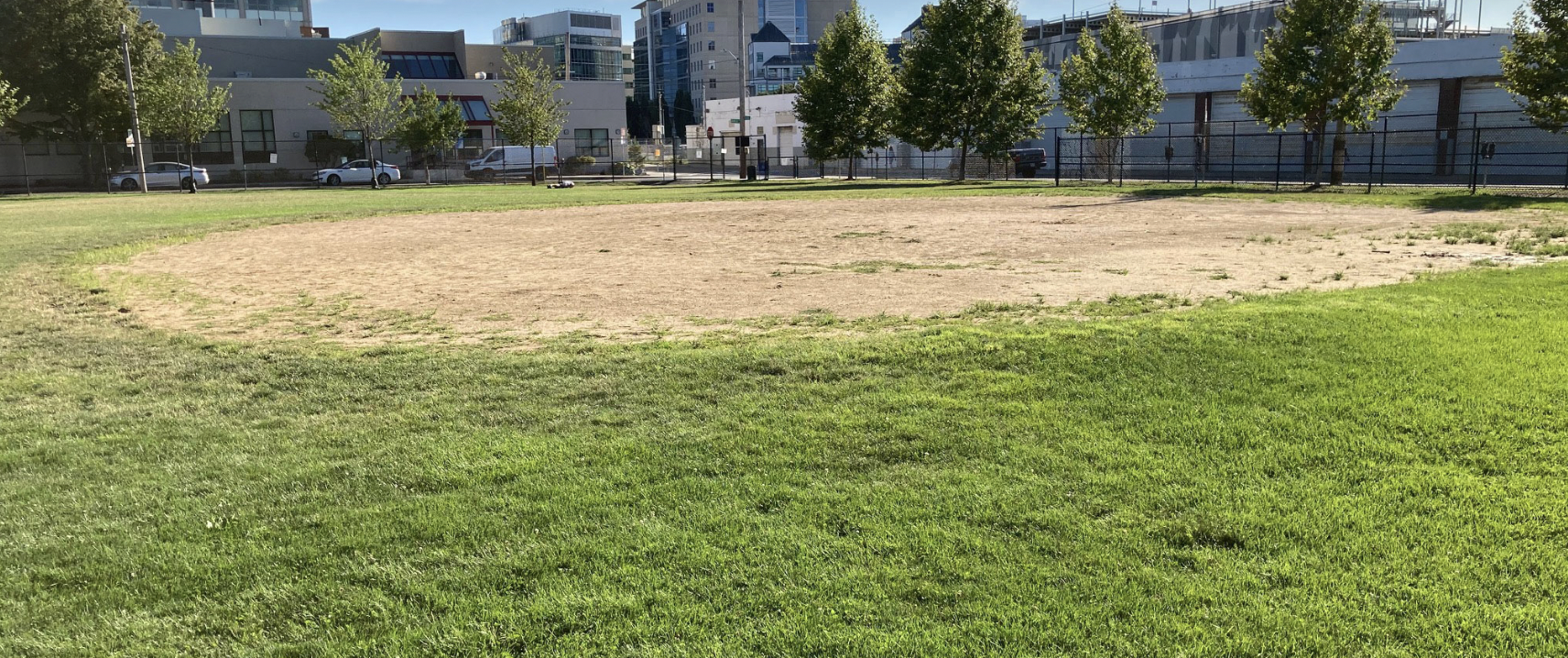
Outcome of turf war over Ahern Field was predetermined
Cambridge City Manager Yi-An Huang and Deputy City Manager Kathy Watkins appeared before Cambridge City Council Monday not to debate whether Ahern Field should have artificial turf but to explain why it will.
Read more Norton Award winner Ken Urban on bringing tough topics to the stage
“We have been moving forward with a plan to build out [an artificial] turf field that I think will allow for significantly more youth sports, especially in East Cambridge,” said Huang. The field is currently natural grass.
Huang said that the change would go forward despite outcry from residents.
The renovation of Ahern Field, a park in a densely populated part of East Cambridge, has caused intense debate. Representatives from Cambridge’s youth sports leagues successfully lobbied the city to address issues with the field, which can suffer the wear and tear natural grass experiences. In public comment Monday, they called the change from turf necessary because of high demand for youth soccer and baseball programs and too few places to reliably play.
But residents of East Cambridge organized in response to the prospect of installing artificial grass on what many of them consider their backyard. They cited the environmental benefits of natural grass in dense urban areas, concerns about higher surface temperatures for artificial turf and the high cost of the project, estimated at $3.5 million.
A number of councillors found themselves sympathetic to these arguments and puzzled by how the city landed on the design for the project. The city council last term voted in favor of the Ahern Revitalization Project as a part of its 2025 budget cycle, and city officials said artificial turf was always a part of its specifications. Councillors said better public engagement at the time would have alerted them to its drawbacks.
“Here we are, in these tough budget times … and we’re investing money in these new fields, which most other communities aren’t doing,” said Councillor Marc McGovern, citing fiscal headwinds in other Mass. municipalities. “And, instead of celebrating that, there’s people that feel really hurt and damaged by this process.”
The issue was first discussed by this council in April, when Councillor Ayah Al-Zubi brought forward a policy order asking the city to not move forward with construction until it could provide a report to council on how the decision was made.
In its report, various city departments including Public Works and Public Health pointed to the inequality in access to bookable field space between northwest Cambridge, home to Danehy Park and Russell Field (which both have artificial turf), and the rest of the city.
Soccer families split on fake grass
“The existing grass field is not meeting the needs of current users or the demand for reliable playing time,” the report stated. It cited frequent grass field closures due to weather and continued damage from high levels of use as factors causing the difference between neighborhoods.
Cambridge resident Raquel Eskrich spoke during the public comment period in favor of the city’s decision to try to alleviate some of the demand by making the change.
“For some of us, getting to other fields can be difficult and time consuming, especially without a car,” she said. “Every child deserves the chance to play close to home.”
Some of Cambridge’s youth sports leagues sent around a petition to try to drum up support for the new space. The petition currently has more than 400 signatures, but is competing with a much more popular petition for a natural grass field, which has over 2,000 signatories.
Many who signed the anti-turf petition spoke during a well-attended public comment period on Monday. They described Ahern as more than just a sports field, but a community space for residents of all ages who want to spend time outdoors.
“Newsflash: Ahern Field is not just for soccer,” said Cambridge resident Laura Holsen. “Fake grass will not serve our community in an equitable manner. It is too hot, too unsafe and too plastic to welcome all the uses that many people enjoy.”
Some of the residents who came to speak said their own families benefit from Cambridge youth sports leagues, but still are not in favor of turf. One of them called the city’s process for deciding on the change “covert.”
Former Cambridge mayor Anthony Galluccio, who coaches for several youth sports leagues including soccer and football, said he wished commenters would highlight the other improvements being made to the field, including the planting of new trees and repaving of the basketball courts. He also said the anti-turf comments were missing the bigger picture.
Read more Public comment shouldn’t be cut short
“If I stood outside a supermarket, and asked people, ‘Would you rather prefer grass than turf?’ of course, they’d say grass. If I stood outside the same supermarket and said, ‘[Is it unfair] that kids in East Cambridge and the Port don’t have access to a 12-month-a-year all-season playing surface?’ . . . they’d all sign the petition too,” Galluccio told Cambridge Day. “I feel like the petition battle is a little bit illusory.”
Public says engagement lacking
According to the report provided by the city, four public meetings were held between June 2025 and March 2026. Members of the public say that by the time the city had reached out to them for their perspective, though, officials had already made up their minds.
Deputy City Manager Kathy Watkins confirmed this, saying that “staff went into the process with the community trying to be very clear that that was … a decision that was already made.”
While construction is not expected to start until the summer, the city has continued to work on Ahern’s new design and begun the process of contracting for the project. Watkins called it “an imminent process that is underway.”
Huang added that the city was listening to resident’s concerns about the environmental and health risks of turf but noted that there were “tradeoffs.”
“I want to recognize that [the decision to use artifical turf] does have some kind of costs, and we are doing everything we can to mitigate those,” he said.
Councillors were unsatisfied with the city’s response, however, and appeared frustrated by both the lack of responsiveness to community members and their own inability to intervene.
“I really believe in wisdom and intelligence and thoughtfulness of our residents,” said Councillor Cathie Zusy. “I think we’re recommending the wrong decision.”
Councillor Jivan Sobrinho-Wheeler, who agreed that he didn’t think turf was the right call, pointed to a broader frustration with the balance of power between the city manager and council.
“I’m frustrated that, at best, the city council was not really engaged on this issue,” he said. “The city council can ask, we can all nine of us say one thing, and the city manager could still do another thing. That’s the structure of the government right now.”
Initially, councillors thought their only option was to place the city manager’s report on file. Partway through the discussion, though, Siddiqui alerted council that they could also vote to table the report, which would keep it on the agenda for at least one more meeting.
The council voted 5 to 3 in favor of tabling, with Councillor Patty Nolan absent.
Sobrinho-Wheeler clarified via email that tabling the city manager’s report does not change the decision made by Huang.
“Tabling the City Manager’s report just means the topic will show up on the agenda again at our next Council meeting,” he wrote. “Only the City Manager has actual power to move forward with the construction of the project or delay it.”
Because the item will remain on council’s agenda, the public will have the opportunity to comment on it once again during council’s next meeting June 22.
Read more CRLS girls ultimate frisbee off to nationals this weekend
