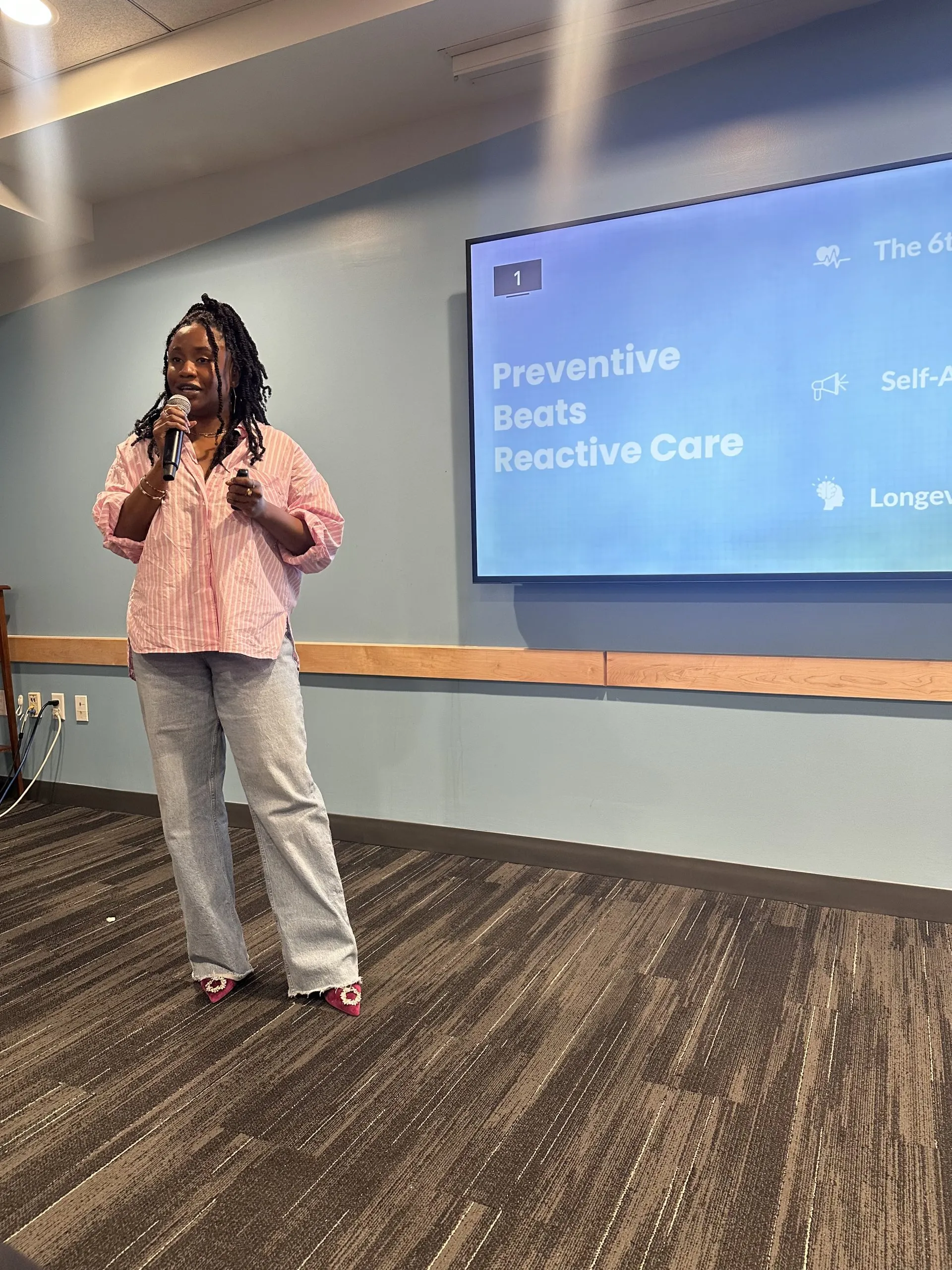
Social impact startups have pitch night at CIC
Two startups, one pioneering burn care for patients and the other educating teens about menstruation, were picked as the winners at a recent social impact pitch event at Cambridge Innovation Center (CIC).
Read more Heat emergency not an anomaly
Prior to the public pitch night, where the audience cast vote for their favorite presentations, the entrepreneurs had pitched to a panel of judges, whose choice was also announced at the event hosted by Venture Cafe June 25. The judges picked SilkMed, which is creating a spray on silk dressing for burns, while the audience picked MyCycleIQ, an app to manage around menstrual cycles.
Reducing pain for burn patients
Silkmed grew out of Sebastian Useche’s pursuit of a master’s degree in Innovation and Management at Tufts. The program encourages students to find a problem and create a business plan around how to solve it. Useche had shadowed the medical director at Brigham & Women’s Hospitals burn clinic and observed patients of all ages “crying, shaking in pain” during the process of recovery.
“It seemed worse than the actual accident,” Useche said. “That’s something that stuck with me.”
Useche met David Kaplan, a Tufts professor who studies biopolymer engineering, and was fascinated by his work. He quickly realized that it could be used to help burn patients by lessening the pain associated with removing dressings, which can adhere to the wound. Kaplan’s technology underpinning SilkMed, which incorporated July 3, 2024.
One audience member who voted for it was Adrianna Gugel, an applicant for the next early growth stage cohort at CIC. “They’re building a better mousetrap for burn patient care, and I think that’s awesome,” Gugel said.
Changing the period cycle
MyCycleIQ founder Samanda Jean, who was the audience’s pick. Jean has been cycle syncing, the process of aligning your workout, diet and lifestyle with your menstrual cycle, for over six years. To understand her health, she had been using her FitBit to make sure she was pushing herself properly each day.
However, she noticed that around her luteal phase, the second half of the menstrual cycle that spans from ovulation to the first day of the period, she’d get depressed and tired. Her FitBit didn’t account for this when it gave her an overview of what her workouts should look like for the day. So, she started developing an app.
At first, the app was designed as a supplement to things like FitBit. However, as she went through the early growth stage of the social impact program, she decided that the app needed to pivot to a different mission.
She saw the effects the lack of menstrual health education can have on someone. So, she decided to focus her app on teenagers and prioritizing their understanding of their menstrual health.
The app gives teens a way to log their periods and understand their cycle and the symptoms that come with it.
Read more Herring and herons: signs of the Charles River’s vast improvement
Accelerating through obstacles
This year marked Cambridge Innovation Center’s fifth social impact cohort, fledgling companies run by historically disadvantaged entrepreneurs within Massachusetts. The entrepreneurs can go through two distinct programs,early growth stage, a three-month program where companies have a product and are working to gain customers, and the other a six-month growth stage, where companies with customers work to expand their operations. Startups from the early growth pool often continue to the six-month growth stage.
Useche, 28, is originally from Ecuador and moved to the Boston area when he was 16. He said he has appreciated the area’s diversity and inclusiveness, but applied for the CIC program because he had faced challenges, such as visa compliance, as an entrepreneur from an underrepresented demographic. He said the program had helped him build a network that eased his problems hiring a team at SilkMed.
He also said being in a community with other early-stage entrepreneurs had helped him through challenges company founders face. “People truly like to be there for each other and help as much as they can,” Useche said.
He said after he received the judge’s pick award he hung the plaque at his home office. It helps remind him of the work he and his team have invested. “Sometimes you feel like you don’t do enough as an entrepreneur,” Useche said. “But having these little wins and learning to appreciate them for what they’re worth is something that I’m working on.”
He hopes to use the award’s stipend to help develop the company’s new prototype.
MyCycleIQ founder Samanda Jean applied to the program after the recommendation from her mentor, Sheila Phicil, who had been part of the program and founded Phicil-itate Change, which helps create health tech for patient care.
Jean, who joined the early stage cohort, said her biggest challenges as a solo founder are managing the startup in the face of the everyday stresses of life. She said receiving the award shocked her. But it also now motivates her.
“To try and run something solo that I’m super passionate about comes with ups and downs,” Jean said. “This was definitely one of the ups that’s probably going to push me for the next year or so.”
The stipend she received will go toward treating her summer interns to dinner. Jean hopes to have a minimum viable product, the simplest version of a product that allows a company to receive feedback, by this fall.
Also in this year’s cohort were Bevy Studios, Collixion Therapeutics, Dri Umbrellas, FitKind, Health for Mankind Company, Kidogo Productions, Menty Corp, ProctR Technologies, and SickPayy.
The night started off with a panel with speakers from the Urban League of Eastern Massachusetts, including Dele Omotosho, workforce development instructor; Dr. Shakenna Williams, the executive director of Frank and Aileen Center for Women’s Entrepreneurial Leadership; and Rahsaan Hall, the president and CEO of Urban League Massachusetts. They discussed barriers faced by entrepreneurs in underrepresented groups and how to overcome them. Then, the cohort was brought up to give a three-minute pitch about their startups.
Read more CRLS track program on the national stage
