Connolly, Miller mostly agree to agree about Beacon Hill
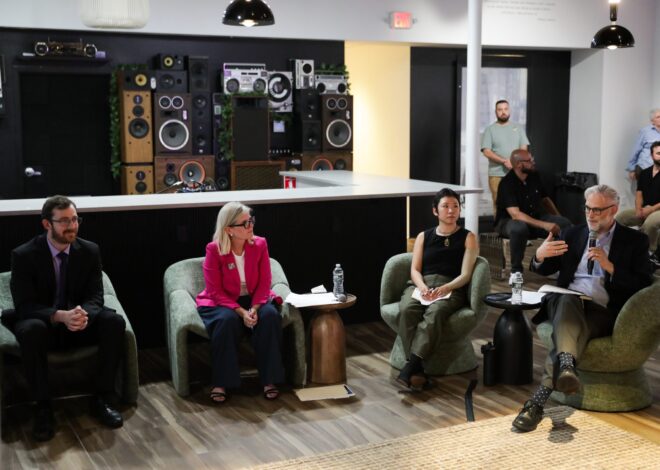
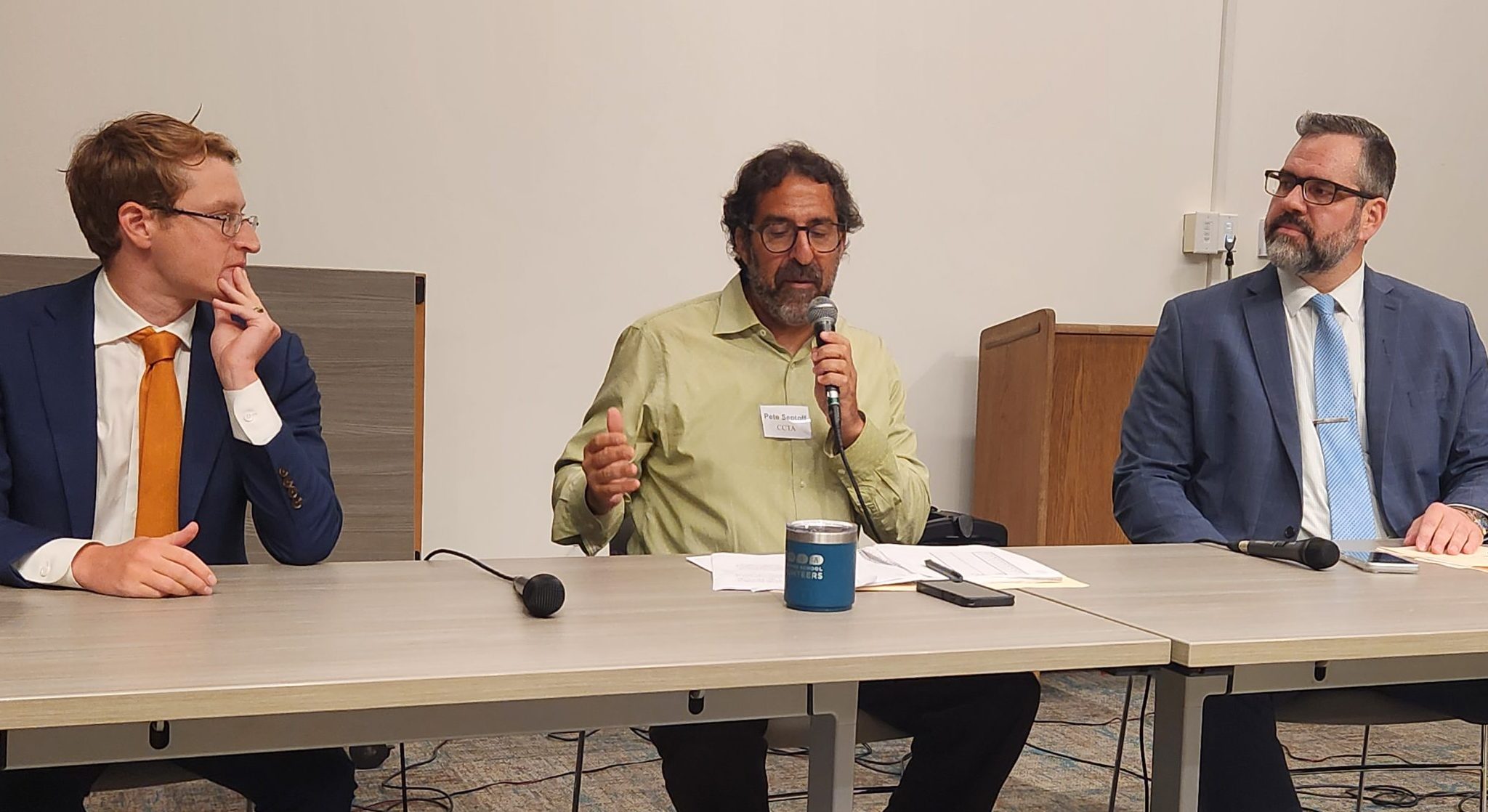
It was more civil discussion than contentious debate. State Rep. Mike Connolly and his challenger Neil Miller largely agreed on the transparency and accountability problems in the Massachusetts legislature and even how to solve them. Their most striking difference was aesthetic: their heights (Connolly is 6’8”, Miller more than a foot shorter).
Read more Somerville, Capital theater buildings put up for sale
The forum was the latest organized by the Cambridge Committee for Transparency and Accountability (CCTA) with the Coalition to Reform Our Legislature (CROL) and the policy nonprofit Act on Mass. The CCTA’s Phil Septoff moderated.
More than 30 people braved a soaking rainstorm July 7, filling a second-floor room at the Central Square branch of the Cambridge Public Library to see the candidates for the 26th Middlesex District, which covers parts of Cambridge and Somerville. Connolly was an aide to former Cambridge City Councillor Dennis Carlone and defeated Tim Toomey, a 12-term incumbent, in the 2016 Democratic primary. This is the first time he’s faced a challenger since. Miller is a Harvard Kennedy School student who resigned his post as a federal data scientist in January 2025. He has lived in Cambridge for several years and volunteered as campaign chair of A Better Cambridge’s Independent Expenditure Political Action Committee.
Areas of agreement
Asked to grade the legislature on transparency, both candidates gave it a C-, and both said it would have been lower had the Senate and the House not recently passed legislation to allow the state auditor to actually audit the legislature, at least a little.
Even so, “we have a state house that all too often fails to do its work transparently and fails to hold itself accountable for results,” Miller said.
Connolly noted that even though the bill was an improvement, he still voted against it, one of only three Democrats in the House to do so. Observers have said it will largely maintain the status quo for the legislature. Connolly repeated the line he shared with State House News Service, “Legislature passes transparency bill out of the cover of darkness.”
Miller decried both the legislature’s lack of transparency and its limited roll call votes, which he said were widely used in other states and could be adopted here.
Asked about the ballot initiative to improve access to public records, both said they supported it and would work to implement it in the legislature.
Experience vs. ideas
Connolly tended to lead with examples from his 12 years on Beacon Hill. Miller put forth ideas for what he would do if elected.
Housing was a particular area of displeasure for Miller, who said he was running because the lack of affordable housing made it impossible for him and his wife to plan for a future in Cambridge. He denounced what he called a lack of action since the Affordable Homes Act was passed in 2024. “We can’t solve a problem by passing a giant bill every two to four years,” Miller said.
He noted that the legislature appeared unlikely to pass a housing bill this term, and “there’s no information on why we’re not passing a housing bill.”
He added that even when there is legislation, “there’s no accountability for things like the MBTA Communities Act and whether they are actually getting results.”
Connolly mentioned several items he had pushed to have introduced as legislation, including “multiple provisions for housing” that were part of the state’s fiscal year 2027 budget, just signed by Gov. Maura Healey.
Read more A different kind of book-worm
On stipends, the controversial practice of paying extra fees to legislators who lead committees, Miller proposed taking the $5.4 million it costs annually and redistributing the money: half for higher base pay for legislators, about $10,000 more each, and the other half “to build a legislative research bureau.” It would support legislators in making better policy, he said. Miller estimated that for $2.7 million, some 20 people could staff that research bureau.
Connolly noted that his very first vote after he unseated Toomey was cast against increasing the number and size of stipends, in the face of what he termed “extraordinary pressure.”
He joked that if he got a raise in base pay “maybe I wouldn’t wear the same suit every time you guys see me.” He said after the forum it is the only suit he owns; Miller also said he wore his only suit.
Connolly thought a research bureau would be helpful to legislators.
Miller also proposed legislative outcome reviews to help gauge how well laws are working. Connolly said he liked the idea, adding that the system has accountability built into its structure, since every two years legislators have to answer to voters about what they have and have not done.
Some areas of disagreement
They did have areas of modest divergence. For passing bills of import, Connolly gave the legislature “something in the C range,” while Miller gave it a D. Miller said Massachusetts is falling behind other New England states in producing legislation, especially when it comes to building more housing. “Connecticut is hardly an urbanist utopia but last year passed legislation that lifted parking mandates. Maine, which I mostly think of as woods, passed a bill to legalize three or four apartment units basically anywhere in the state (with infrastructure),” Miller said
Omnibus bills also were a point of contention. An omnibus bill lumps many different types of bills into a single broad piece of legislation. But it means that lawmakers do not vote on individual bills, which both candidates agreed limited transparency and open debate.
Connolly said, however, that the procedure can help pass bills that otherwise would fail. He noted that the omnibus budget bill had probably 48 different pieces of legislation in it, including several housing-related components he thought “might not get done in an up-or-down vote” on a stand-alone bill. “There is real resistance to housing across Massachusetts,” he said.
“Opposition research”
The one awkward moment in the hour-plus forum came when Miller brought up a $425 payment expense Connolly’s campaign paid to a private investigator, disclosed in May, two months after Miller launched his own campaign.
“I’m really curious to find out what this all about,” Miller said, wondering if it was looking into his background. “I find the whole thing really funny, but that’s the kind of stuff that makes it harder for people to take the step, run against what a lot of people in this room would see as a corrupt, insider-favoring political system. The number one thing we need to do is make it a little bit easier for people to put their name out there.”
Connolly smiled and confirmed his campaign team suggested a basic background check on Miller, “opposition research.” He added, “I’m pleased to say that $425 did not return anything I thought anyone would be concerned with.”
Connolly drew laughs from the audience when he added, “we are in this moment where we’re having a national conversation about vetting first-time candidates,” in reference to the Maine U.S. Senate race, where Graham Platner ultimately had to withdraw after multiple controversies.
Read more Copper Mill developer accused of default
The primary election is Sept. 1.