Moulton on affordability, research support and AI regulation
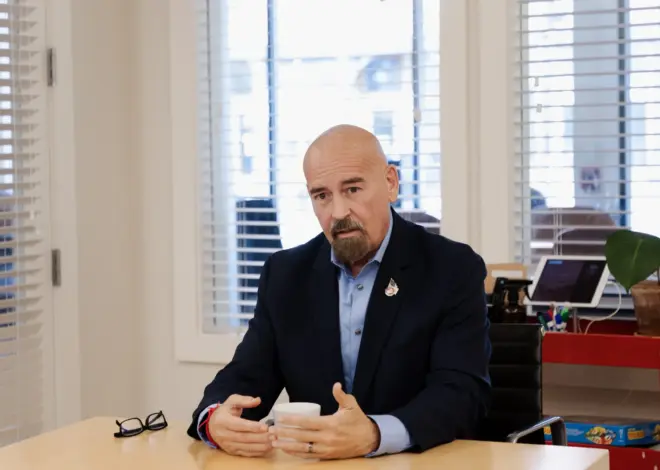
Journalists from The Belmont Voice, Brookline.News, Cambridge Day, Lexington Observer, The Waltham Times and Your Arlington Now met with U.S. Rep. Seth Moulton, D-Mass., who is a candidate for the U.S. Senate. The same group will also meet with Sen. Ed Markey, D-Mass.
Read more Bautista’s defendant arraigned, charged with murder
U.S. Rep. Seth Moulton, D-Mass., discussed priorities for the communities largely along the Route 2 corridor, including why a regional railway will promote affordability, the type of legislation he would propose on AI regulation, his plan to address the U.S. Immigration and Customs Enforcement department, and how to protect the biotech industry and higher education in Cambridge in wake of a slew of federal budget cuts and endowment taxes. But his broadest priority if elected would be to aggressively pursue a path to a more affordable environment through a plan that would include universal healthcare.
“Housing, healthcare and education should be human rights,” Moulton said. “I’ve put forward this Affordability agenda around that framework. It’s completely unacceptable for people to be outside sleeping in Harvard Square without housing, just like it’s completely unacceptable for people in America, no matter what their status, to not have healthcare.”
Moulton voted in favor of the 21st Century Housing Act, aimed at lowering housing costs and expanding housing supply, and said his affordability agenda includes plans to invest more in the construction of affordable housing. In addition to affordable housing, he outlined plans to create a high-speed railway system that would connect eastern and western parts of the state, opening access to more affordable communities.
Previously, Moulton has cited Cambridge as a leader on affordable housing development. In addition to taking inspiration for future affordable housing plans from Cambridge, he also explained that his plans for making Massachusetts more affordable go beyond housing.
Moulton, who receives government healthcare through the Department of Veteran Affairs, explained that his universal healthcare plan would still let people opt for private insurance. But he said it was essential that underserved populations receive access to medical care. “Universal healthcare across the board is not debatable, not an exception, and I think that more than anything will drive down the cost of healthcare,” Moulton said.
For Cambridge specifically, which has an economy facing long-term threats from sweeping cuts in research funding and increased endowment taxes for Harvard University and the Massachusetts Institute of Technology, Moulton said the solution to funding restoration is electing more Democrats across the board. “They’re [Republicans] going to keep attacking Blue states and Blue cities,” Moulton said. He called this ironic, since “we’re donor states, we give more to the federal government than Red states and yet Trump is attacking our funding purely out of political vengeance.”
Read more Remembering Brit d’Arbeloff
He said “the way to stop that is not to plead to Trump … the biggest thing we need to do, is we need to win elections.” Moulton said this is why he founded Serve America, which works to get people from public service backgrounds elected.
AI and ShotSpotter
Artificial intelligence is everywhere these days, and Moulton said regulating it differently will be a major emphasis of his if he is elected to the Senate. He said regulating AI would be more challenging for his rival, Sen. Ed Markey. “I don’t think people look at the 80-year-olds in the United States Senate and think they’re going to figure out AI,” said Moulton, who is 47. “It’s time for the generation that grew up with the internet and is going to have to live for decades with AI to actually be building the policy we’re actually going to have to live with.”
Moulton also said AI regulation should be driven by the states, not the federal government. “One of the things I support is state by state regulation,” he explained. “Although in the long run you want to have federal regulations, we should absolutely allow innovation at the state level … we need states to innovate and we need communities to propose laws and that’s how we can start to hold these tech companies accountable.”
Asked about surveillance technology such as the ShotSpotter gunfire detection system, a source of controversy since Cambridge City Council voted to remove it from the city. Moulton said the current scope of surveillance technology writ large is “frightening.” However, if properly used and regulated, he believes it could be helpful in instances of crime detection.
“You’ve got to be really tech forward when thinking about these issues,” he said. “On ShotSpotter, I think the concerns [about the technology] are very valid and I also think that the concerns of people who are worried about safety in their community are valid. I’m not a local policing expert, but if there’s a legitimate case for the value of ShotSpotter in reducing crime then I think you can hold both these things and balance them.”
The Massachusetts primary election is set to take place on Sept. 1.
Brianna Earle is reporting this summer for Cambridge Day as part of a partnership with the Brandeis University journalism program.
Read more Cambridge issues heat advisory