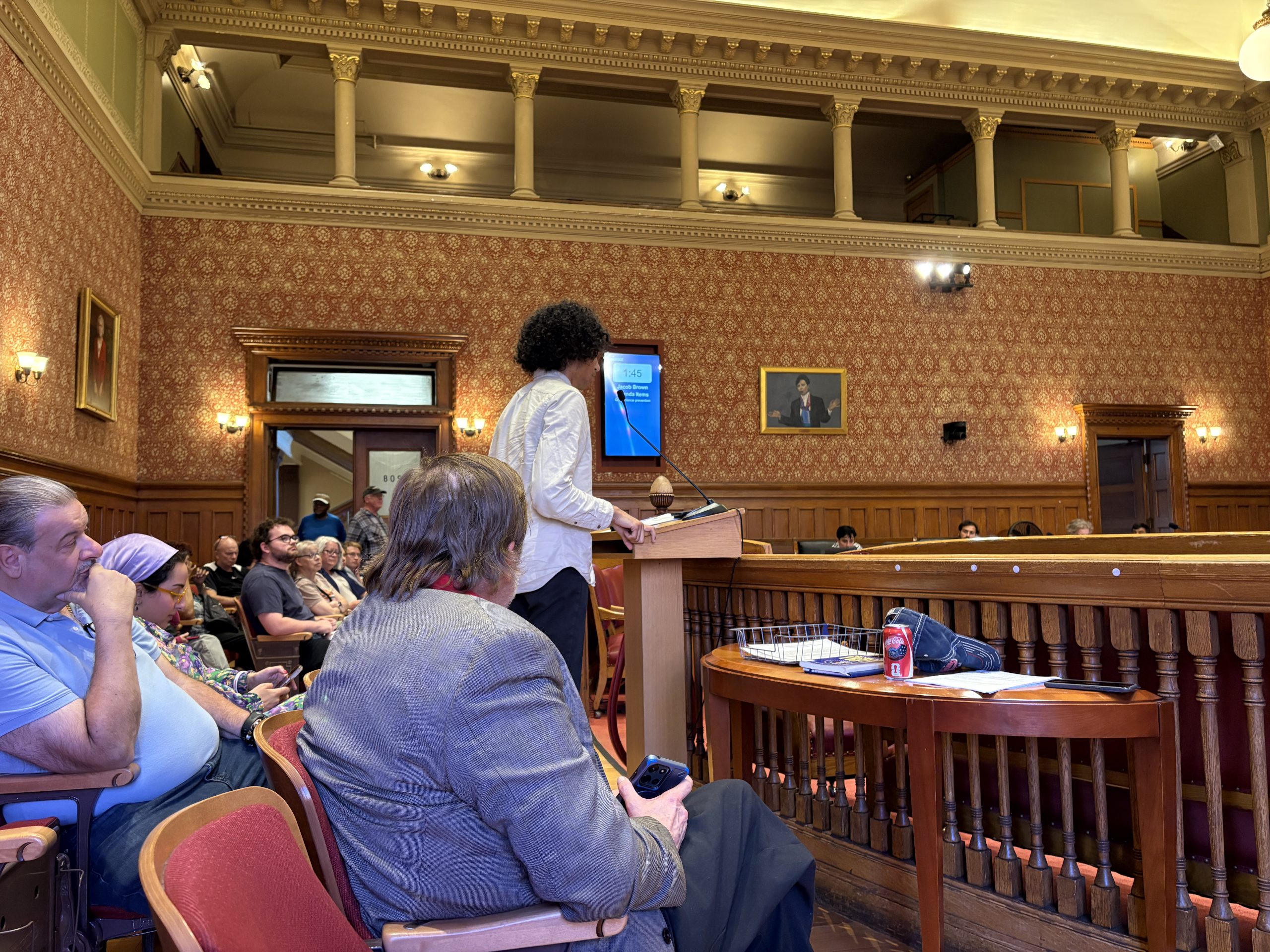
City Council delays ShotSpotter vote during special meeting
Despite four dozen public commenters and hours of debate, Thursday’s special meeting of Cambridge City Council meant to address public safety concerns ended with no action when Councillor Ayah Al-Zubi used her charter right to delay a vote on a policy order to reinstate ShotSpotter.
Read more Planning Board, Ordinance Committee pan Brown petition
Her action was greeted by groans from the roughly 10 spectators who still remained. Councillor E. Denise Simmons, who with councillor Tim Flaherty had proposed reinstating the sound-detection technology for 90 days, immediately left.
Councillor Marc McGovern urged the council to stay civil. “My plea to all of us, those who support ShotSpotter and those who don’t, really is sort of let’s not politicize this issue and drive each other into corners.”
The special session of council was called to try to resolve divisions in the community in the wake of the murder of Xavier Bautista, a Cambridge resident and Department of Public Works employee shot and killed July 4. Ideas discussed ranged from reinstating ShotSpotter to better supporting the Cambridge Safety Department (CSD).
Before she invoked her charter right, Al-Zubi criticized the council for politicizing Bautista’s death.
“When you turn a community meeting into a political opportunity for ShotSpotter, when you incite fear in a place of vulnerability, I’m lost in that conversation,” Al-Zubi said. “I will entertain conversations on technology when and only when we have adequate support and funding for community-based organizations within the Community Safety Department.”
All council members were in agreement about the need to improve public safety.
“Every one of us in this chamber wants the same thing,” Simmons said. “A city where no family has to bury their child, no mother has to put their son or daughter in the grave, and think about what if, what if we had done more? What would have happened?”
Debate about effectiveness
Much of the meeting focused on ShotSpotter, an automated gunshot detection technology, which the council voted 5-2-2 to remove from Cambridge on May 18.
It started with a parade of public commenters, of which 48 were registered. The vast majority opposed ShotSpotter. Critics of the technology raised privacy concerns, called it a quick fix and brought up data questioning its efficacy.
Sophie Gillard, a Cambridge resident, said “It’s clear that ShotSpotter is not good at deterring crime. ShotSpotter is good at surveilling us, and in particular, spying on our low-income and Black and brown neighbors. Do not bring ShotSpotter out. Do not engage in reactionary politics.”
David Berkinsky said the technology detracts from other violence prevention and response programs. “These are Band‑Aids that do not actually address the root causes of crime and violence. In fact, they often exacerbate the problem and at the same time take away necessary resources from programs like Cambridge HEART and violence interrupters.”
HEART is a community-based effort to encourage alternate responses to crisis situations. Its president and chairman, Quinton Zondervan, a former City councilor, called for more funding for organizations like HEART, “community-based organizations that are actually working on preventing violence.”
Read more Union contract proposals will mean “18% increase” to district budget in first year, Murphy says
Some want ShotSpotter back
While far fewer comments were in favor of ShotSpotter, many of its supporters were people of color, the community most affected by violence in Cambridge. They urged the city to use any means necessary to improve public safety.
“Possibly reinstating this technology, if done carefully, can help resolve crimes that would otherwise go unsolved and may help prevent others,” said Ellis Washington, senior pastor at St. Paul AME Church. “When shots are fired, every second matters … if there’s technology that may help first responders locate the victims, hear a scene, recover evidence, or identify the person responsible, I believe it deserves careful and transparent evaluation, and not a decision that’s made and set aside without a full public accounting.”
Jacqueline Adams, who lives in The Port, said she has experienced the impact of ShotSpotter. She criticized the City Council for removing the technology without replacing it, saying “It is beyond my comprehension as to why a system was removed before an alternative solution was set into place.”
During discussion about the policy order to restore ShotSpotter for 90 days, Acting Police Commissioner Pauline Wells had a direct exchange with Sobhrino-Wheeler about the technology. Wells said that of the three Cambridge shootings in 2025 that resulted in injuries and were in an area of ShotSpotter coverage, none resulted in an alert. Two were indoors and thus out of range, and one was a drive-by. Of the nine shots fired in Cambridge that year, only three resulted in alerts.
Wells acknowledged ShotSpotter’s system is less effective on July 4 — when fireworks make gunshot detection more difficult — but said when Bautista was killed, “at 4 a.m., ShotSpotter would have been using regular detection with no suppression.”
Community members and councillors agreed on the need for broader safety improvements.
McGovern said the city needs to address the factors that contribute to crime. “We have to do better about how we talk about this. We have to be better about who we include in this conversation. On the issue of addressing the root causes of violence, yes, yes, yes, yes and yes. Better funding for mental health, housing, addressing poverty, creating more opportunities for young people, fixing our two-tiered education system, and so much more.”
City Manager Yi-An Huang gave updates with city safety experts on violence prevention efforts, the CSD’s work and the city’s summer community programs. Kwame Dance, the CSD’s recently hired assistant director of violence prevention, said he hopes to address “the feeling of safety in the community,” as well as improve more traditional metrics such as crime rates and incarceration rates.
The Department of Human Service Programs’ Michelle Farnum, assistant director of Children, Youth and Families, urged the council to think about safety in other ways, as well. “I would invite councilors to think about engaging with community members who are not here, not just about finance and violence prevention in different ways,” Farnum said.
Two other policy orders were on the agenda. Councilors Jivan Sobrinho-Wheeler, McGovern and Al-Zubi asked Huang for an evaluation of violence prevention and response strategies. Mayor Sumbul Siddiqui, Sobrinho-Wheeler and Councilor Patty Nolan requested an update on the city’s unarmed response strategies.
Read more Campaign 2026: With six weeks to go, a roundup of candidate fundraising
