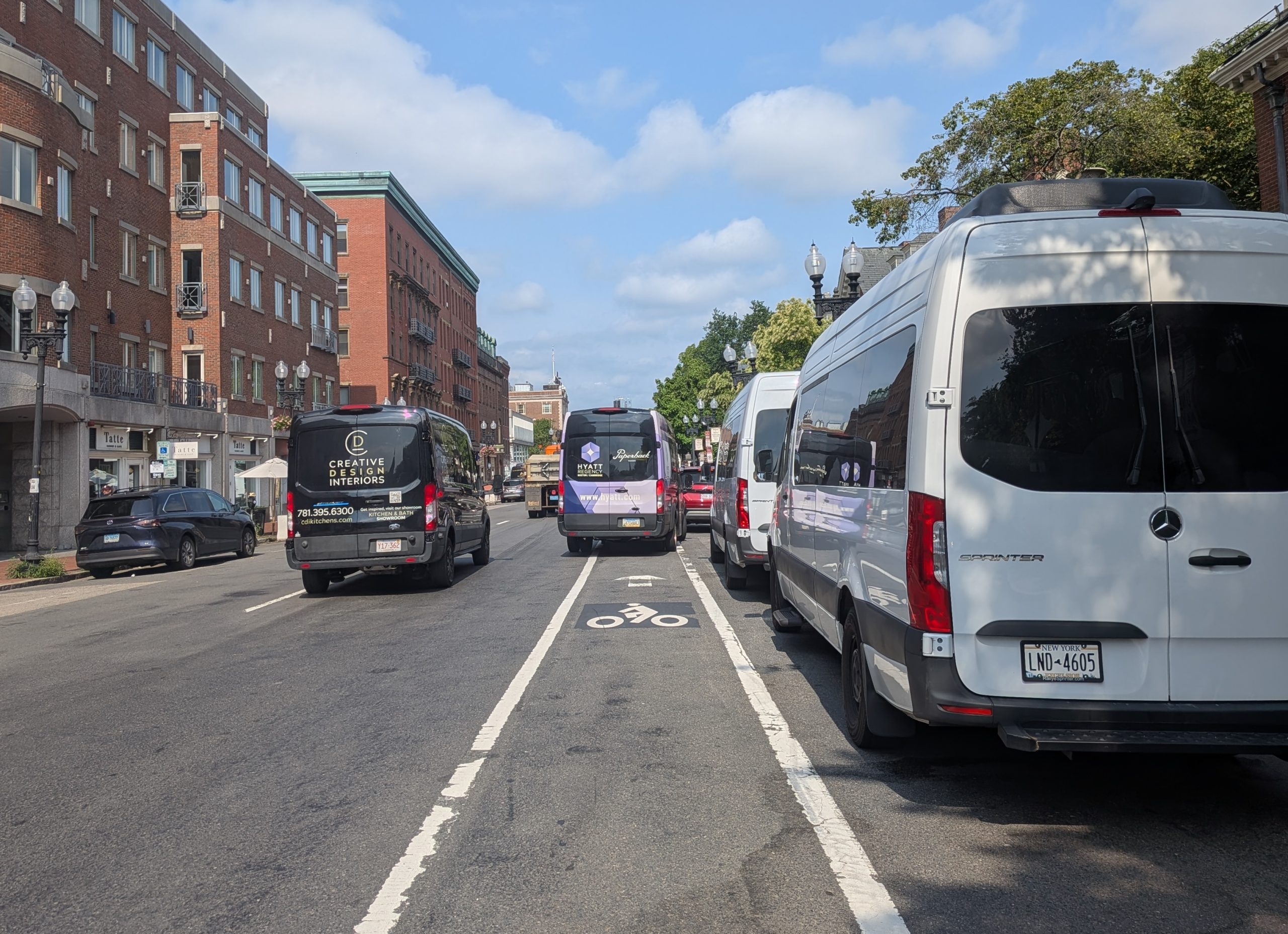
Can an app get rid of parked cars in bike lanes?
A new app, Bike Bureau, offers local cyclists a way to document the perennial problem of cars parked in bike lanes.
Read more MIT’s Fab Lab marks 25 years of making almost anything
Here’s how it works: if a cyclist sees a car in a bike lane, they can open the Bike Bureau app on their phone. Their camera will hone in on the car in front of the phone and take a photo. Then, the anonymized photo is uploaded to a public database.
Bike Bureau’s founder Jonathan Lansey lives along the waterfront in Boston and commutes to Kendall Square for his job at Cambridge Mobile Telematics. On his ten-minute commute, he says he normally passes, on average, ten parked cars in bike lanes.
Before developing his app, “I would just be super angry,” he said. To avoid weaving in and out of the bike lane and into traffic, he would ride in the left lane, which felt dangerous, too. But his anger wasn’t going to solve anything.
“I’m a person who likes to build things,” he said. “And, I know a lot about the technical back ends of how various government systems record things.”
So, Lansey began working on Bike Bureau in early June and launched it by the end of the month.
“Now my commute is a lot more fun,” he said. “I’m helping to leave a paper trail for what is a real infrastructure issue.”
Bike Bureau is a progressive web app, which doesn’t require a download. Although the app requests location permissions, granting location is not necessary for the app to function. The app also blurs identifying details like faces or license plates before the image is uploaded to Lansey’s server.
“A report being anonymous is still useful … the infrastructure is the problem and not the individual people driving,” said Lansey.
Currently, the app requires a Google account to use, which Lansey says he thought would prevent abuse of the system.
“I wanted to make it as easy as possible for people to report these issues so that we get the most visibility,” he said. “We also don’t want to waste our city officials’ time.”
There are similar tools for reporting bike lane obstructions, but Lansey says his is the only one that integrates with cities’ official reporting channels. He says this can be helpful for cyclists who are constantly crossing city lines and aren’t always aware of which jurisdiction they’re in and what the appropriate reporting process is.
The way Bike Bureau connects to local cities’ databases is via an API key. Once a city creates one for Bike Bureau, it allows the app to submit reports, which include the vehicle’s license plate, to the city.
The app can be used anywhere, and so far, it files reports to 25 cities, including Cambridge and Medford. Lansey is hoping to add Boston and Brookline, where he says the need is high.
The app comes at a time of anger, frustration and grief in the local biking community, following the death of Boston transportation planner Louisa Gag, who was killed in mid-July by a truck driver near Roxbury Crossing while she was biking to work.
The prevailing sentiment among bike safety advocates is that a protected bike lane, one that uses physical barriers to separate cyclists from moving vehicles, would have prevented Gag’s death. Such barriers — bollards, curbs, even parked cars — also block cars from parking in the lane, which Lansey is trying to document.
Cambridge’s ‘part of the whole’
Dylan Thrush moved to Arlington from Portland, Ore. last year and began cycling as soon as the weather allowed.
Read more For Cambridge Historical Commission, zoning ordinance has ‘changed the calculus’
“Some areas are very nice and pleasant to use and there are some that are neglected and are obviously dangerous and scary,” he said.
Thrush bikes to Harvard Square every week to climb at Central Rock Gym.
“The most positive thing I can say about [that commute] is that it’s exhilarating,” said Thrush, who begins his ride on the Minuteman Bikeway, before cutting over to Massachusetts Ave. There, he is sandwiched between parked cars, where a driver could open a door at any moment, and a lane of traffic.
“There’s almost always an obstruction that requires you to get into the road to go around it,” he said, adding that he was almost hit recently by a car turning right.
Although local cyclists say bike infrastructure is better in Cambridge and Somerville, Thrush says that’s no reason for the cities to rest on their laurels.
“I would hope that everyone looks at, and scrutinizes, their part of the whole,” he said. “I would hate for the reaction [to Gag’s death] to be ‘That happened on the other side of the city. We do things differently here; no action required.’
I would hope we say, ‘Oh, we have a dangerous intersection here, and even though no one might have been killed here, we can preemptively work to make that safer.’”
In Cambridge, where three cyclists died in crashes in 2024, the city is nearing its deadline for completing its current bike plan. The city’s Cycling Safety Ordinance, originally passed in 2019, was amended in 2020 to order 25 miles of protected bike lanes by November 1, 2026. Many of the city’s main thoroughfares, including all of Massachusetts Ave, and most of Broadway, are slated to include separated bike lanes under the ordinance. While some residents are championing the effort, the changes are rankling others concerned about the reduction in parking.
In Somerville, the city approved its Bicycle Network Plan in 2023, which proposed 29.8 lane miles of protected bike lanes by 2030 (two lane miles on a protected bike lane equals one street mile).
When Thrush first learned of Bike Bureau via the Bike Boston subreddit, he says he was curious and excited, “mostly because there was a tool for doing something besides just being grumpy and thinking rude thoughts.”
“It just looked too convenient to ignore,” he said. “The process is so easy and slick. I can spare five seconds to pause and pull my phone out and snap a picture.”
Thrush says in his “perfect utopia,” there would be a reduction of parking and physically separated bike lanes at minimum.
“I’m hoping for some meaningful action and change, and having data to back that up is really important”
Not every local cyclist is drawn to Bike Bureau, however.
“I do not want to be on my phone while biking,” says Alexa Jakob, a Somerville cyclist and volunteer at Somerville Bike Kitchen. “I do not want to stop. I have places to be.”
While “it helps to have the data,” Jakob says “it’s not the entire fight.”
Addressing safety “is more a political will problem than a technology problem,” Jakob said, referencing Boston’s pause on street safety measures. “The problem is that the people in power won’t do anything. The problem is not that we don’t have enough software.”
Of the local cities that Lansey has invited to receive reports from Bike Bureau, Cambridge and Medford have begun receiving reports.
Currently, Somerville, Boston, and Brookline have not responded officially, though Lansey says a Boston transit official has thanked him for his offer.

