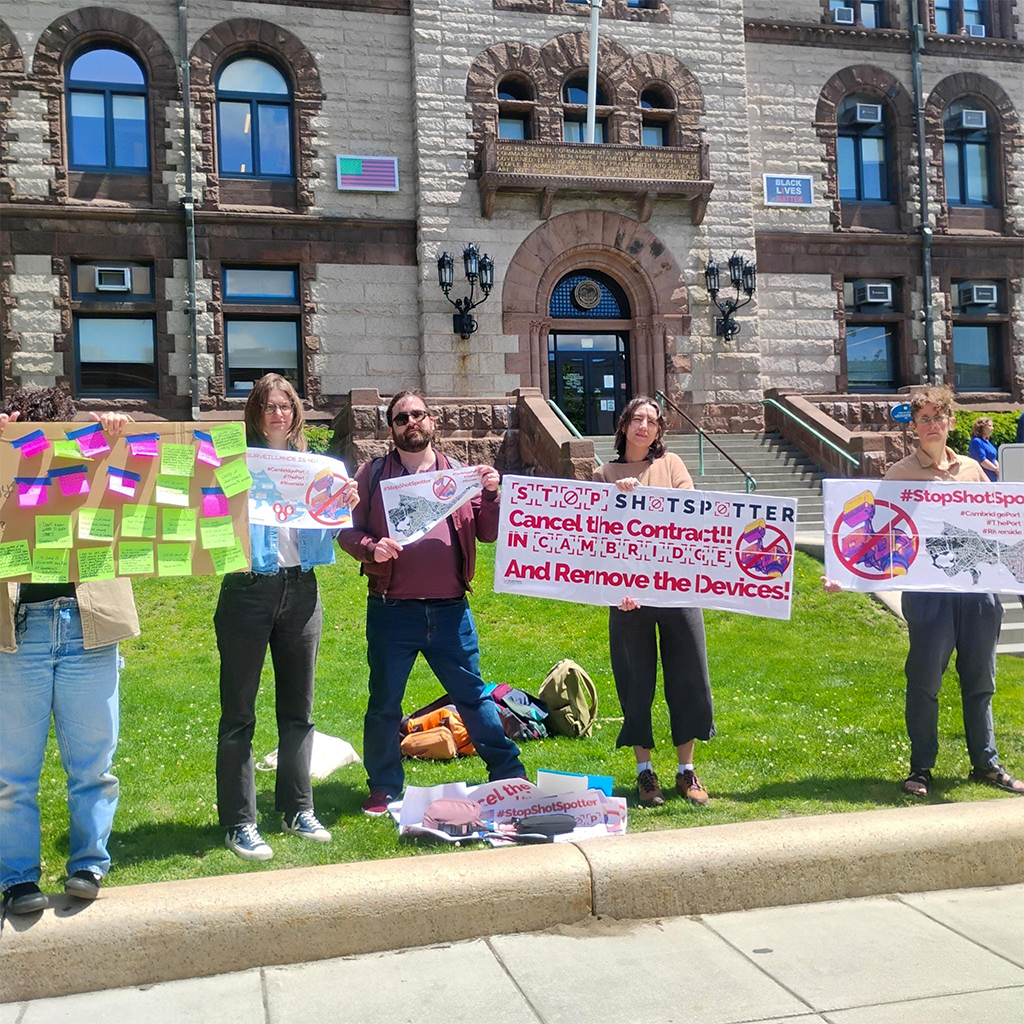
ShotSpotter vote evokes strong feelings at City Council
Hours after a shooting on Memorial Drive shook the Boston area, Cambridge City Council took up a previously scheduled vote on whether the Cambridge Police Department (CPD) should continue using ShotSpotter, a technology that identifies gunshots.
Read more Protecting our engine of innovation
Councillor Ayah Al-Zubi introduced a policy order to direct the city manager’s office, and in turn, CPD, to stop using the program within 90 days. The order came out of a public safety committee meeting on April 29; Al-Zubi chairs that committee. At Monday’s meeting, more than a dozen advocates spoke in favor of the measure. In her remarks, Al-Zubi said “the question becomes not who does ShotSpotter share data with, but who can ShotSpotter share data with.”
But an impassioned speech by Councillor E. Denise Simmons was followed by Vice Mayor Burhan Azeem’s exercise of his charter right to move the item off the agenda, closing further debate until next week’s meeting.
Concerns in committee
ShotSpotter, a service provided by Fremont, Calif.-based SoundThinking, uses a network of microphones to detect and alert local police when explosive sounds over 120 decibels are recorded. The company claims more than 180 cities use its service.
The city began using the technology in 2014. Concerns about the security and accuracy of the data that ShotSpotter collects have caused councillors to reconsider its use. ShotSpotter’s microphones pick up more than just the sound of gunshots and are continuously recording. At April’s public safety committee hearing, John Boyle, CPD Deputy Superintendent, compared it to a home smoke detector. “It’s on, it’s running,” Boyle said.
CPD receives recordings from one second before a shot was fired to one second after, Boyle said, noting that data is overwritten every 30 hours. But Spencer Piston, a Boston University political science professor, said in other cities, prosecutors have used conversations recorded and provided to them by ShotSpotter as evidence in cases.
“The reason we know that conversations are always being recorded is because they’ve been introduced in court,” Piston said. “Not just conversations after a shot and before another shot, but conversations that were before any gunshots that were happening.” He said ShotSpotter’s recording system might violate Massachusetts’s anti-wiretapping statute.
The city’s Surveillance Technology Ordinance gives City Council the power to revoke its approval of policing technology like ShotSpotter. During the April meeting, councillors raised concerns that data picked up by ShotSpotter microphones could be sold or shared — especially to federal immigration enforcement.
Cambridge’s ShotSpotter program is funded through FEMA, which is a part of the Department of Homeland Security (DHS), through its Urban Area Security Initiative. Immigration and Customs Enforcement (ICE) is also part of DHS. ShotSpotter’s contract is technically with the city of Boston’s Department of Emergency Management.
“I am worried about who owns the information, who they share that with and what they do with that information, especially in the climate that we’re in right now,” said Councillor Marc McGovern during the committee meeting.
Acting Police Commissioner Pauline Wells tried to assuage councillor concerns, saying “there have been no incidents where immigration and customs enforcement has requested any ShotSpotter data from CPD or SoundThinking. We will not, do not, and have not shared any information with ICE.”
However, City Solicitor Megan Bayer noted that the City of Cambridge only licenses the data collected by ShotSpotter microphones — SoundThinking owns it.
That limits what Cambridge can control. “There’s no opportunity for the city of Cambridge, whether that’s an individual resident or the city government or even the police, to object to SoundThinking doing anything with data that’s recorded in our city,” said Mason Kortz, an attorney with the Harvard Cyberlaw Clinic who has been representing The Black Response, an advocacy organization that is a member of the Stop ShotSpotter Camberville Coalition.
There are also questions about ShotSpotter’s efficacy. According to CPD’s presentation at the hearing, 35 percent of ShotSpotter activations have been confirmed cases of gunfire, giving the system a false positive rate of 65 percent. That would be an improvement over 2019, when a Harvard Crimson article noted the false positive rate was about 82 percent, a statistic cited by several public commenters at Monday’s City Council meeting. A 2024 analysis done by New York City’s comptroller and a 2023 investigation by the Houston Chronicle each found false positive rates above 80 percent in their respective cities. Also, police departments in cities like Chicago and Dayton have declined to renew their contracts.
However, Cambridge police officials at the committee hearing said ShotSpotter has been useful, saying that since 2015 ShotSpotter has recorded 11 instances where a gun was discharged and no 911 call was made.
Read more CRLS Sports: Baseball continues to roll, boys’ volleyball splits
“Officers receive shot spotter alerts directly on their phones and cruiser computers, which has led to faster responses and prompt medical assistance when seconds can make the difference,” Wells said.
Inequitable sensing?
An analysis of a leaked national ShotSpotter dataset by Wired magazine showed that people of color are also much more likely to live near a ShotSpottor sensor. According to an analysis done by The Black Response, as of early 2024, all of Cambridge’s ShotSpotter microphones are east of Harvard Square. Shootings in neighborhoods with a higher concentration of black residents like the Port were more likely to get picked up by ShotSpotter microphones, while shootings in areas like Neighborhood Nine did not get picked up by ShotSpotter mics. ShotSpotter was not activated during Monday’s incident, according to police spokesperson Sgt. Robert Reardon, who said that section of Memorial Drive lies outside of the system’s radius.
During public comment at Monday’s city council meeting, more than a dozen speakers called on the city to stop using ShotSpotter.
“Our sanctuary city status is pretty much meaningless if we have a surveillance system that is constantly monitoring Black and Brown communities,” said Cambridge resident Ben Amado.
“It makes Cambridge a more oppressive place to live for all of us, but particularly for its Black and Brown residents who are already targeted by racism in so many other aspects of their lives,” said resident Lois Markham. “Is this what we want the city to whom we pay taxes to be doing? I don’t.”
Many speakers represented advocacy groups, including the American Civil Liberties Union, Democratic Socialists of America, Digital Fourth (a local organization against government surveillance), and The Black Response (which promotes alternatives to police in Cambridge).
“ShotSpotter cannot be determined to have any effect on gun violence whatsoever,” said Alex Marthews, co-chair of Digital Fourth. “We can address gun violence in many ways … but this particular technological solution does not work.”
Simmons raises questions
When it came time for councillors to discuss the policy order, Simmons, whose son Anthony was killed in a 1995 Brockton shooting, said some of the public comments did not represent how many people in predominantly Black neighborhoods in Cambridge feel about ShotSpotter.
“I want to be vested in the people that I’ve been sent here to serve. The people that look like me, that you may or may not have talked to, that I think deserve to be heard, even if they are different from what your perspective is,” she said. “I’m not a ShotSpotter enthusiast, I just feel that the process is exclusive, that it infantilizes a group of people.”
Simmons said she was considering supporting the policy order but in speaking to her neighbors changed her mind. Some of her Riverside neighbors had never heard of ShotSpotter, she said, and in the past, when shootings have occurred, residents have requested the installation of security cameras.
She also said that during the meeting a “sense of performative [allyship] and saviorism of marginalized people,” had also rung out.
“Have you had your son shot down in the street? I have,” she said. “I wouldn’t exercise the charter right, because I couldn’t sit through another evening of this.”
But Azeem then invoked his charter right to move discussion onto the next meeting’s agenda.
“I think emotions are running a little high, so I just want to give us a week to lower the temperature and reflect,” he said. “I think we’ll have a really good discussion about this next week.”
