Fifty years since recombination debate ushered in biotech in Cambridge
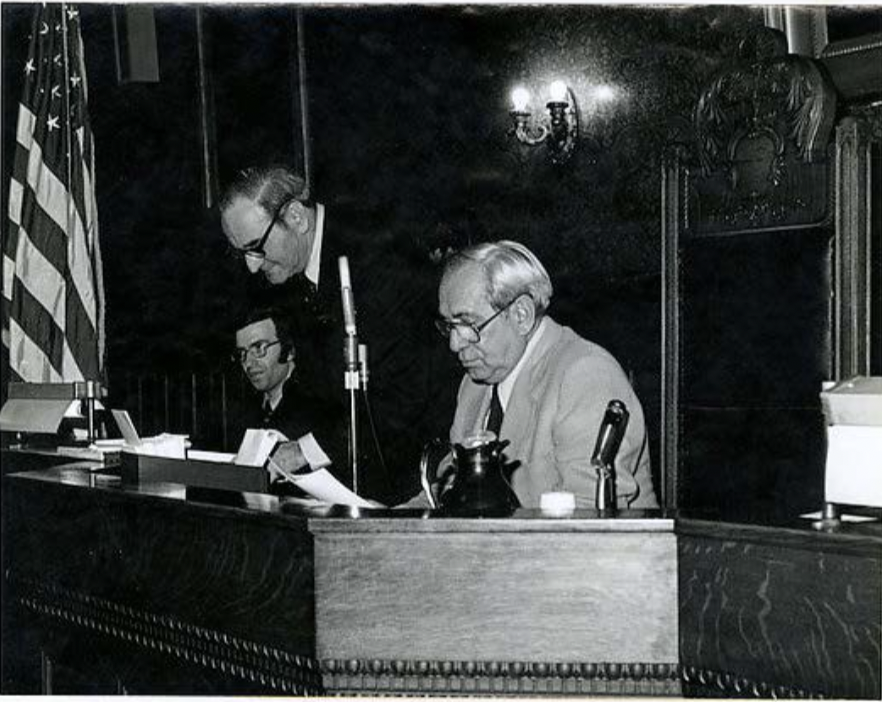
This month marks 50 years since Cambridge city councillors, scientists, and residents debated the safety of DNA recombination. The fiery deliberations at city hall elevated the role of the public in scientific research, which resulted in the nation’s first local ordinance regulating genetic experimentation, and led to the biotech boom in Kendall Square.
Read more Cambridge Local first to host second annual 617 Day small business summit
Looking back on history, the Cambridge recombination debate wasn’t just a news story, says Sam Lipson, Cambridge’s director of Environmental Health. It was also a parable about the public’s tipping point.
‘No recombination without representation’
In 1976, Harvard University planned to renovate a research lab to conduct viral and genetic research at an elevated biosafety level. But when members of its biology faculty and the public raised concerns, the city of Cambridge held public hearings in June on whether the lab should be built. The question it asked: Would recombination research endanger the public?
Then-Cambridge Mayor Al Vellucci loathed Harvard and played up his revulsion during the hearing.
“Anything could come out,” he said of a possible lab leak. “It could be anything. It could be contamination, infections, something that could crawl out of the laboratory, such as a Frankenstein.”
Little was yet known about recombination, which blends DNA from different sources to create new DNA sequences. When testifying scientists were grilled with questions like, “Is there zero risk of danger?” they relied on the language of probability, which didn’t play well with laypeople.
The nation was still reeling from a number of scandals, from the Vietnam War and Watergate to the Tuskegee and Willowbrook experiments. So although scientific experimentation had not been interfered with before, trust in institutions had fallen precipitously and now the public demanded transparency.
Residents picketed outside city hall with signs reading ‘No Recombination Without Representation.’ Some councillors assumed the research was deeply fraught for it to become a matter of public debate.
“There must be a great division that now the political world — us who are known to make crazy decisions — now has to settle an issue in the scientific world,” said then-Councillor Saundra Graham during the hearings.
Graham was right; there was concern among scientists whether recombination was safe or not, with Nobel prize winners on both sides of the issue. The hearings lasted two days and resulted in a six-month moratorium on recombination research while an advisory board of citizens formed to assess the threat of danger.
Looking back, Cambridge resident Bob Neer, who later helped create local regulation for private recombination research, admires the scientists who drew back on research.
It was “noble,” he says, for them to voluntarily pause their work while the city worked through its concerns. But putting their pipettes down had an unintended consequence. Neer says citizens interpreted it as an admission of guilt.
“People thought, ‘Where there’s smoke, there’s fire. Otherwise [scientists] wouldn’t accept limitations.”
This caught some in the scientific community off-guard, Neer says. He says it never occurred to them that their work would be suspected as dangerous. This assumption could cost them. It would be up to the newly appointed Cambridge Experimentation Review Board to decide.
Over four months, these seven Cambridge residents met twice a week. The group included a nun who worked as a nurse at a local Catholic hospital. A clerk at a typewriter ribbon company. An urban development scholar. A physician. No one had any biology research experience.
The group ran themselves like a jury, hearing arguments from both sides. In the end, scientists who favored recombination research had the more polished argument. And, existing data was on their side.
Despite the rancor of the initial debate, the members of the review board were united when it made its recommendation in December. Recombinant DNA research should move forward, they said, but only if scientists followed safety guidelines adapted from the National Institutes of Health. City Council — Vellucci included — encoded this guardrail into law in 1977. Additionally, the Cambridge Biohazards Safety Committee was created to enforce it and it still exists today as the Cambridge Biosafety Committee.
Read more Events this week in Camberville: Wax museum, Fresh Pond Day, & soccer watch parties
A biotech boom
What happened here sparked a movement, says Lipson, who chairs the Cambridge Biosafety Committee today. The way Cambridge handled recombination regulation launched similar debates in city halls from Princeton to Berkeley.
These conversations were “anticipatory,” says Lipson. “It was a matter of principle.” Ultimately, eight other cities and two states passed their own laws about DNA research.
By the 1980s, when private companies wanted to open labs in East Cambridge for the same purpose, tempers had cooled and there was a framework for making big decisions about research. Cambridge resident Neer was a part of creating a system of oversight for private companies, which was stricter than the original guidelines for universities. Once it was in place, the permitting and inspection process Cambridge placed on companies didn’t discourage recombination research; it seemed to encourage it.
In 1983, when the genetic engineering company Biogen opened its first U.S. facility in Kendall, Lipson says Cambridge’s knowledge of the field and its community-created oversight were part of the city’s appeal.
Many more firms followed. Now, Lipson says, 130 biotech companies hold permits for biological research in Cambridge alone.
“By the time recombination became more routine, Cambridge had already established traditional oversight. It was seen as very valuable. It’s fascinating how Cambridge rules became accepted as good practice in the industry,” says Lipson.
Despite the economic downturn the biotech industry is currently facing, Cambridge is still a destination for the field. Last year, Biogen broke ground on its new global headquarters in Kendall Square, consolidating its Massachusetts locations.
The debate’s enduring legacy
Since recombination research expanded, there have been no known public health crises linked to it — here, or anywhere else.
“People realized recombination events were happening all the time. What scientists were doing experimentally had been going on since creation,” says Neer. “And, I’m sure people found it a nuisance, but the rules turned out to be pretty easy to follow.”
This month offers the city a chance to reflect — MIT Museum has a brief exhibit on the debate through June 21 and is hosting a symposium on Friday marking the recombination hearing’s 50th anniversary. It is also co-producing a theatrical production with Central Square Theater running in June to dramatize the debates at Cambridge City Hall.
In recalling the 1976 debate, Cantabrigians primarily remember it as fractious. And it might have been this intensity that drew Neer to public service in the first place. As a father to two children in Cambridge Public Schools in the ’70s, he once attended a meeting about the search for a new superintendent that ended in a fistfight.
“That’s how steamed up people were in those days,” he recalls.
But rather than deter him, Neer says the fight motivated him. “I was so horrified that I decided that I needed to get involved in Cambridge politics. I felt that responsible people needed to get involved.”
If Cambridge faced a debate today involving the public health consequences of new and complex technology, could residents have a civil conversation about it?
“I don’t see why not,” said Neer. “We just have to start.”
Residents do not need to search long for modern parallels. Last year, the city hosted a town hall meeting to discuss a future shaped by artificial intelligence. In 2024, local researchers published the risks of “mirror life” — creating synthetic lifeforms by “reversing” the physical structure of biological molecules. Scientists at MIT and Harvard are developing ways to utilize gene editing techniques, like CRISPR, to alter genes within living organisms.
Lipson says that the way councillors, researchers and residents handled concerns about research 50 years ago has shaped the way he thinks about communicating with the public now.
“Lead with the information and the desire to learn more,” he advises. “Don’t assume anyone wouldn’t want to know about this.”
Read more ‘Birds Up Close,’ and other picks for what to read
