Rediscovering America’s Orwell
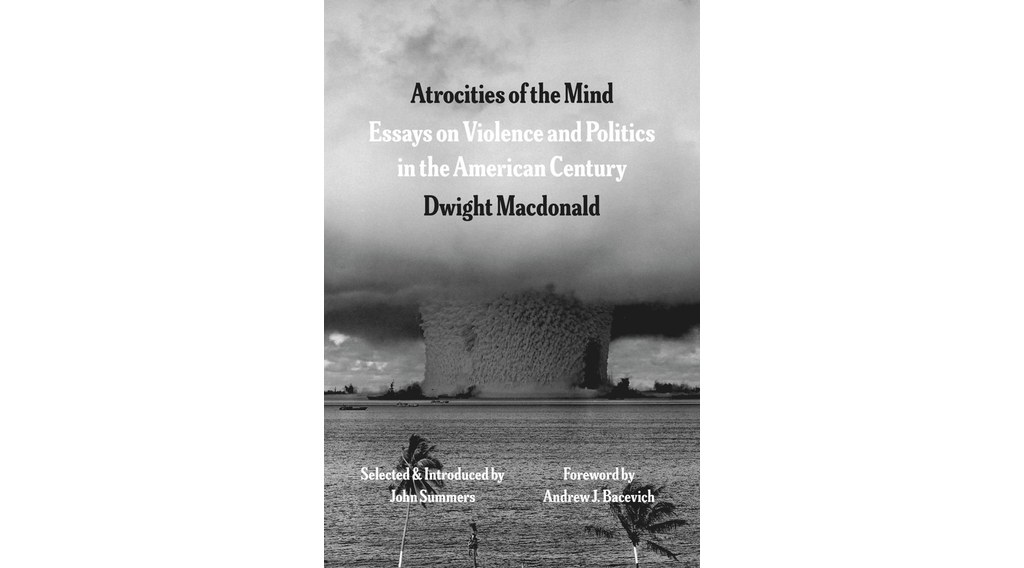
“Atrocities of the Mind: Essays on Violence and Politics in the American Century,” by Dwight Macdonald, selected and introduced by John Summers. University of Chicago Press, 2026.
Read more Events in Cambridge and Somerville: Cambridge Dance Party, Fourth of July, Pico Opera
Dwight Macdonald was hailed as one of the greatest essayists of the 20th century when he died in 1982. He should be a model writer for today’s anxious America, as we are reminded in a new collection of his work edited by Cambridge-based historian John Summers, “Atrocities of the Mind: Essays on Violence and Politics in the American Century.” Macdonald, a descendant of the founder of the Massachusetts Bay Colony, was a pedigreed populist who came to call himself a conservative anarchist. He was a writer at Fortune, edited Partisan Review, founded Politics magazine, and then wrote for The New Yorker. Christopher Lydon, the host of “Open Source,” interviewed Summers and gave Cambridge Day permission to excerpt their conversation.
Christopher Lydon: It seems to me Dwight Macdonald becomes our American version of [George] Orwell, which is to say the stylish prose guy we still love for a mix of both affection and asperity he brought to looking at his country. Here’s Dwight Macdonald on returning to New York in 1957 after a year in Europe.
“We are an unhappy people, a people without style, without a sense of what is humanly satisfying. Our values are not anchored securely … There is a terrible shapelessness about American life. These prosperous Americans look more tense and joyless than the people in the poorest quarters of Florence. We have more of everything a human being can conceivably, and inconceivably, want … yet we are … not happy.”
Why not? is always his nagging question and especially, why are we so violent?
John Summers: You’ve given his answer — because we are so violent. The nation at this point is basically still on war footing. Macdonald was very interested in this concept called the permanent war economy. He was very critical of the New Deal for not solving the Depression; the only thing that solved the Depression was war … and the nation remained kind of on edge in the Cold War period with the mass-consumption economy. He talked about consumerism as a kind of narcotic. It doesn’t exactly put you to sleep; it puts you on edge.
CL: He writes [citing James Agee writing about poor Americans], “‘Why is it things always seem to go against us? How were we caught?’ How has it now happened to all of us so that ours has become, in a scant two years, a nation hated and feared and despised in the way Hitler’s Germany and Stalin’s Russia were. ‘In what way were we trapped? where, our mistake? How might all these things have been different if only we had done otherwise? If only we might have known? How did this all sink so swift away?’”
Sounded to me like 2026. He wrote that in Vietnam War time, 1967. For me, the pleasure of Dwight Macdonald is that he feels so alive in our world, yours and mine.
JS: Yes, I think he does. He’s the guy who is reading the magazines, he’s reading the newspapers, he’s talking to a lot of people, and he’s trying to figure out what he thinks about things, what is happening, and he approaches political questions and ethical questions, not as a geostrategist or a movement leader, but from the standpoint of an informed citizen.
He has a wonderful essay called “Politics Past.” He looks back on his career in the 30s as a tepid communist fellow traveler at first, then as a Trotskyist, then as a pacifist and anarchist, then as a liberal anti-Stalinist. And he hangs up politics, and he says, ‘you know, I’m sort of done with all this.’ And almost as soon as he finished writing this, he’s out in front of the Waldorf Astoria in New York with the War Resisters League, and he’s the oldest person on the picket line. He was a seeker, and he was willing to change his mind.
CL: You know, it’s a kind of enviable but incredibly challenging role he’s given himself to be philosophical and literary and political all at once.
JS: He was a creature of magazines; he never wrote a proper book; he was one of the great American essayists. So in these gyrations of political affiliation … he did take a lot of grief from a lot of his contemporaries for changing his mind. And he was often not taken very seriously. And yet, it’s this very quality — when you begin a good essay, you don’t really know where it’s going to end. But when you read his essays, you’re reading someone who is not exactly thinking out loud … but trying to convince himself what he thinks. And he had this quality of lightheartedness and self-irony that’s very rare in a political writer.
CL: Norman Mailer said … you could disagree with him on all sorts of things, but you never doubted his fundamental honesty.
Read more A super summer flick and one with eerie edge
JS: That’s right, his moral honesty. Yes, it’s a high compliment. And Hannah Arendt said the same thing.
CL: That’s high praise from a very critical mind. Here we are deep in Trump time, and we don’t have anybody out there who sounds anything like as awake and critical as Dwight Macdonald does. Let me read a short bit of an essay he called “The Bomb.” He wrote it in 1945. Hiroshima was barely cool.
“It seems fitting that the bomb was not developed by any of the totalitarian powers … but by the two democracies, the last major powers to continue to pay at least ideological respect to the humanitarian democratic tradition. It also seems fitting that the heads of these governments by the time the bomb exploded were not Roosevelt and Churchill, figures of a certain historical and personal stature, but Attlee and Truman, both colorless mediocrities, average men elevated to their positions by the mechanics of the system. All of this emphasizes that perfect automatism, that absolute lack of human consciousness or aims, which our society is rapidly achieving. As a pile of uranium, once the elements have been brought together, inexorably runs through a series of chain reactions until the final explosion takes place, so the elements of our society act and react, regardless of ideologies or personalities, until the bomb explodes over Hiroshima. The more commonplace the personalities and senseless the institutions, the more grandiose the destruction.”
JS: Yes, the key word that leaked out to me in that passage is automatism, which was his focus in his essays, the first of which is called “The Responsibility of Peoples,” which is about the “Final Solution” before it was called the Holocaust. Macdonald was the first American writer or intellectual of any stature to write about this subject. … [T]he phenomenon that he identifies is this sense that society has taken on this quality of mechanical automatism, that it just reproduces itself, regardless of human will, regardless of human evolution. He says something to the effect of, never in centuries has the individual been so powerless. And yet at the same time, so much horror has been done in the name of the individual by the state.
CL: Macdonald had a sort of midwife’s role in the birth of anti-poverty programs in America after the early ’60s. President Kennedy had not read “The Other America” [Michael Harrington, 1962] about the poverty that afflicted one in four Americans in that era. What President Kennedy did read was Dwight Macdonald’s New Yorker review of that book. And then it seemed that everybody read it. “The problem is obvious,” Macdonald summed up: “[T]he persistence of mass poverty in a prosperous country. The solution is also obvious: to provide out of taxes, the kind of subsidies that have always been given to the public schools (not to mention the police and fire departments and the post office) — subsidies that would raise incomes above the poverty level so that every citizen could feel he is indeed such. ‘Civus Romanus sum!’” — meaning, “I am a Roman citizen,” in Latin. Until our poor can be proud to say “Civus Americanus Sum:” “I’m an American.” “[U]ntil the act of justice that would make this possible has been performed by the three-quarters of Americans who are not poor, until then, the shame of the Other America will continue.”
JS: President Kennedy read Macdonald’s review in The New Yorker, and he asked Walter Heller, who was the chairman of his Council of Economic Advisors, to do something about this. And policy was beginning to be developed when Kennedy was killed, and then Lyndon Johnson at his State of the Union address a few months later declared war on poverty. So it was the most consequential essay he ever published.
Macdonald died in 1982, and at the time he was hailed as one of the great American essayists of the time, of the 20th century.
CL: We don’t hear people talking about, ‘did you read that essay or had you catch that critique?’ I don’t know where I’d look for it today. We do have a lot of Substacks, we have a lot of magazines, N+1, for example, which I think is aspiring to the standing of Dwight Macdonald, the voice, the independence. Is that hopeful?
JS: Well, perhaps, yes, it’s good it exists and other magazines like it exist. But one thing that’s happened is there is a chill. There is a censorship in the air now that there wasn’t then. I think people are a lot more afraid to say what they really think. Macdonald took a lot of risks and within his community he took a lot of jibes, but ultimately he was respected for his honesty. It’s much harder to get that kind of reception now. There’s no question that Macdonald would have been writing about Gaza and writing about it in terms of, the mass victimization.
Christopher Lydon is the host of the “Open Source” podcast. You can hear the longer version of this conversation at radioopensource.org.
