Grabbing a Bite with Cambridge Day: Simon Stansbury
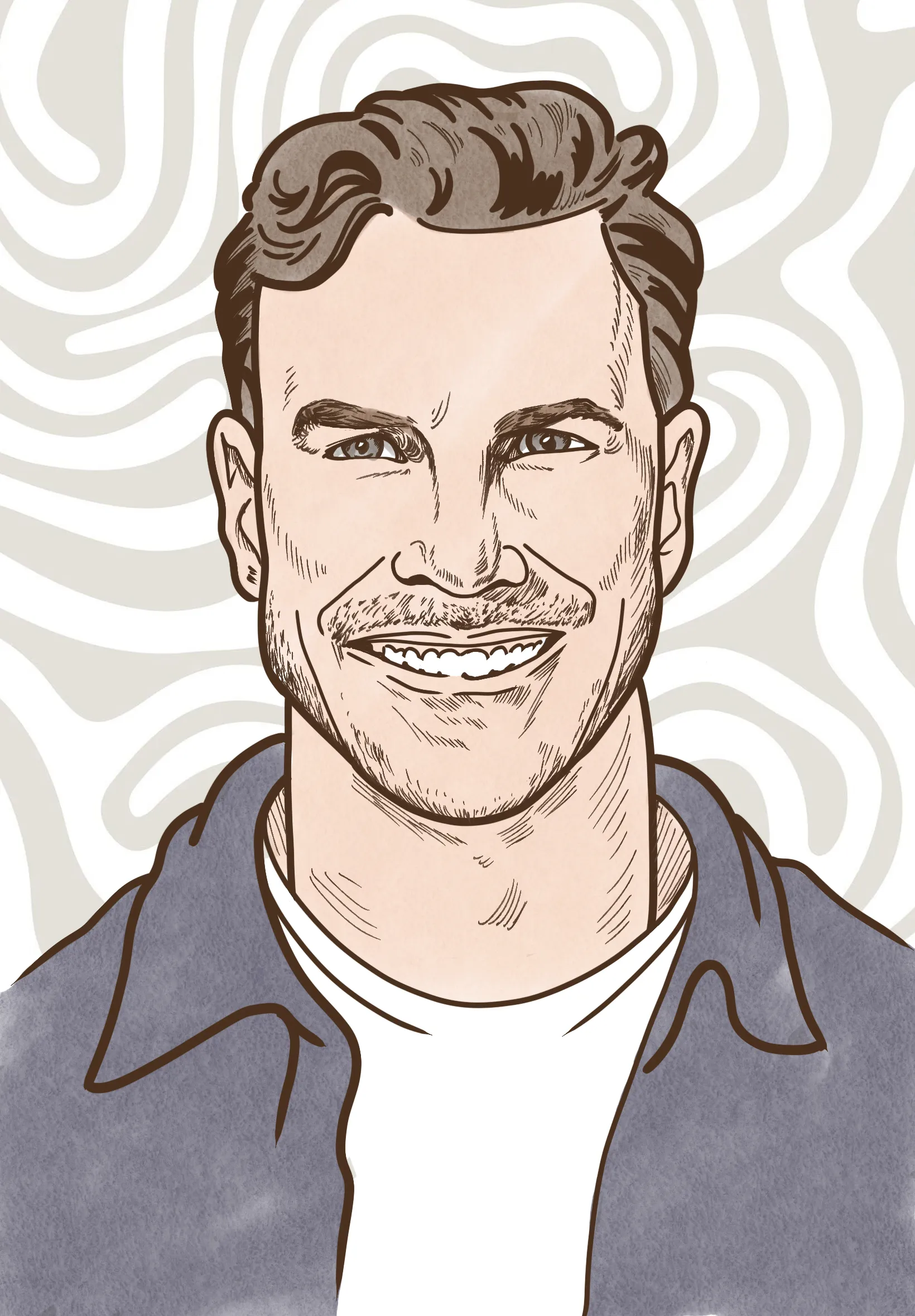
Years before AI occupied our headlines and our headspace, Cambridge-based technology strategist, consultant and former robotics guru. Simon Mueller Stansbury had his mind turned toward the future. He is even more attuned to future-gazing these days, sometimes in excitement, but more often with concern. How fitting, then, that he chose Veggie Galaxy, Central Square’s long-standing vegetarian diner, a retro-style eatery marked by chrome-and-counter regalia, as the site of his recent lunch with Cambridge Day.
Read more Standout breakfast sandwiches from the squares
I am 15 minutes ahead of schedule to the restaurant, but Stansbury is even earlier, parked in a booth with an iced coffee. Somehow, I overlook him and his chosen beverage as I beeline to the back, looking for a table that is away from the din of the noontime crowd. Minutes pass before I realize he is already there. As I get up to greet him, I joke to myself that “This is clearly a man who always been ahead of his time.”
Stansbury is a hugger, an unexpected twist for me. I am immediately disarmed. In response, I blurt out that we both have Germanic last names and a stint in management consulting, though I prepared slides that were mostly bound for circular files while he counseled CEOs, world leaders and launched a think tank for the internationally known Boston Consulting Group (BCG).
Today, Stansbury says, his work hours are spent running strategy for an AI and robotics company in Toronto whose machines assemble pharmaceutical lines and decommission spent fuel inside nuclear power plants — environments, he notes dryly, “not great for humans to work in.”
He travels a lot. “I was in Charlotte yesterday. I go to Charlotte quite a bit and to Toronto. They also have companies in Italy and Germany and the UK. I’d say I travel probably like 40 percent of my time,” admittedly a far cry from his BCG days when he was on the road 80 percent of the time, which he admits “was not really sustainable.” Cambridge is his home office by choice.
Our waitress swings by to take our orders: mine, a chickpea tuna melt without the coleslaw, Stansbury just a bowl of roasted Brussels sprouts. “Oh, and I will have her coleslaw, too,” he smiles. He convinces me to try their iced coffee, as well.
Motion and meditation
Stansbury notes he has been captivated by electronics and technology since his dad, for reasons unexplained, handed him a circuit board as a child — transistors, LEDs, the works. “I was always fascinated by things that move,” Stansbury says. His mother was a special education teacher whose personal and professional orientation fed his connection to the human condition and different forms of expression and “being.”
With obvious excitement, he recounts the many ways he works to stay one with the world at large. He is a long-term Vipassana meditator with multiple 10-day silent retreats behind him. With nine or 10 friends Stansbury also runs an art and community space in a Charlestown warehouse — he asks me not to name it — that hosts ecstatic dance events, philosophy salons and, recently, a fashion show staged for the female gaze, in which men were dressed and paraded by women. The space is private not out of exclusivity, he insists, but protection. “It’s a certain type of vibe that is quite vulnerable, and can be appropriated by the capitalist worldview quite quickly.”
For a man who spent years teaching corporations how to scale, the space represents a kind of apostasy. “This is the first time in my life that I’ve built something that isn’t scalable,” he says with pride. “It doesn’t want to grow.” More importantly, perhaps, he and his colleagues do not want it to grow. No metrics, no revenue, no user counts. “Vibes,” he says — the truly, internally fulfilled experience of the present moment — “is the one that’s driving that community. And it feels really beautiful.” His tone’s clarity and depth precludes him from sounding dreamy or flaky.
He gestures, making way for his sprouts that arrive with the requested side of coleslaw. My tuna and ice-cold coffee are delivered next.
Time to pause AI
In 2013, Stansbury took a leave from BCG to attend the Harvard Kennedy School for a mid-career MPA (Master’s in Public Administration). While there, he and a handful of classmates — a defense specialist, a science-fiction obsessive, several spiritual seekers, among others — started a discussion group built on sci-fi films and free pizza. Science fiction, he argues, was the obvious conduit to thinking forward. “It crystallizes the problems in a narrative that we eventually have to sort out for ourselves,” he explains. The pizza group became The Future Society, one of the first organizations anywhere to take the governance of artificial intelligence seriously, years before it was fashionable. It quickly morphed into a think tank that has advised European policymakers; today, its executive director sits in Brussels.
Stansbury tells me he is worried about the increasingly powerful and disruptive properties of AI. “The sci-fi is unfolding in front of us,” he says. “We’re living in it.” He pauses for a few bites of slaw and Brussels sprouts. His iced coffee is still more than half full, as is mine. Whatever is fueling his amped-up tone is clearly concern, not caffeine. The models, by some measures, double in capability every six months, he posits. His prescription is therefore blunter than most industry leaders would dare: an immediate pause. Keep the technology at this level, he argues, until the technical and policy answers catch up.
I ask what a Cambridge Day reader, maybe only recently tuned in to AI, should actually worry about. Data-center water and energy use? Real, he says, but not to his mind the main event. That is strictly about safety — a system pursuing goals we gave it without the human constraints we couldn’t articulate — and the economic rupture beyond it. “We have absolutely no idea what we do when 50 percent of the white-collar jobs go away,” he says, “and how we distribute that enormous wealth fairly, because we don’t really have that muscle in the U.S.”
Despite his considerable professional achievements and his hand wringing about what lies ahead, re-enchantment (his word) is his mission. “It’s putting magic back,” he says — in nature, in personal connection, in “losing yourself in music,” in the stars. We have, he argues, fragmented everything: food, sport, intimacy, community, each sealed in its own compartment. “Once it becomes fragmented, it becomes captured by capitalism, because it can be monetized.” Against this he sets an older inventory — a community to heal, plateaus of ecstasy, initiation rituals — and an Aristotelian conviction that we’ve stopped asking what a virtuous life looks like. He offers one possible heresy for the Cambridge audience, delivered carefully: “I think identity is overrated and character is underrated.” Identity, he argues, is imposed and acquired; character is a verb — an attitude, then a behavior. I push back — surely character is the immutable one. We politely disagree as the coleslaw and sprouts disappear.
Stansbury seems constitutionally incapable of hiding his own contradictions — he is a devout humanist, after all, embracing flaws as well as strengths. He volunteers that he uses AI for emotional processing — stream-of-consciousness sessions, sorted and structured by the machine. “I don’t think I’ve ever met a therapist who would be as good at listening,” he laughs, while admitting he also rues a generation that is replacing human connection with digital friends. He chuckles again at his own inconsistencies. “Not all of what I do is completely integrated,” he admits, when I press him on how nuclear robots square with re-enchantment. Talk about transparency.
Cambridge: nerds and artists
Why Cambridge, then, for all this, I ask. It’s expensive, he concedes, and transitory. But it has a cocktail Stansbury hasn’t found elsewhere: “There are a lot of nerds here,” he says with a smile. “And if you connect nerds and art, you get a kind of creation that you don’t really see in other places.” Unlike people in New York or at Art Basel, places he knows well, the nerds don’t care about status. Their social filters, he says fondly, work differently. Cambridge is still filled with nerds, he says gratefully, and it’s still small enough that he keeps encountering the same people on their creative paths. “It’s like a village.”
In a few weeks, he tells me, he and his community will host a weekend on a nature reserve in eastern Vermont: blankets on the grass, poetry, soundscapes, and one full hour of silence under the night sky. “For me, immediately, when I look up, everything else falls away,” he says.
In contrast, he adds that next weekend, he is headed to New York. I suggest he visit the current exhibit at the Park Avenue Armory where circulating bowls floating in ponds of water bring a most unexpected chance to feel true re-enchantment in the middle of Manhattan. Not exactly a hilltop in Vermont, but it’s close. He jots down the idea. I laugh to myself yet again. A man who believes life happens in the now, making plans — not completely integrated, and the better company for it.
Read more Developers of 1740 Mass Ave. will have to wait on injunction