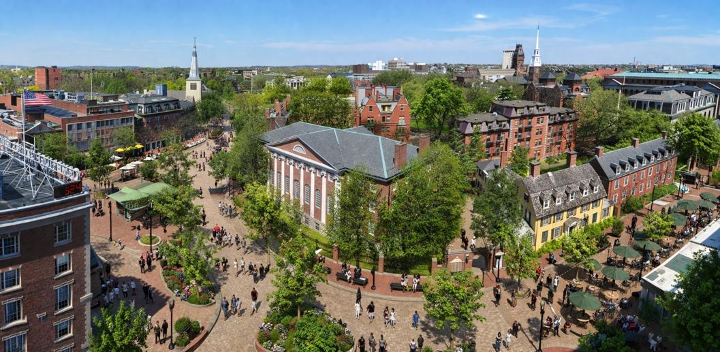
Imagine Harvard Square without cars
Imagine Harvard Square on a busy afternoon. Instead of gridlock on Mass. Ave., you see pedestrians filling the street. Instead of car engines rumbling and honking, live music from a local band carries across the square. Instead of summer heat reflected from asphalt, you sit back under lush trees, sipping coffee as a band plays.
Read more Wellness startup to launch product for Long COVID symptoms
These are only some of the joys car-free spaces can bring. The benefits go much further.
Public squares are important community places. In an “epidemic of loneliness” where fewer Americans have close friendships, we need to create spaces for people to meet. Rather than letting cars dominate the square, we should host events, performances, and programming to connect the community. Imagine having space for Cambridge Public Library pop-up events and more local farmers selling fresh produce.
Data from the EU Urban Mobility Observatory shows that car-free city centers can benefit from an increase in pedestrian visitors. Pedestrians are more likely to stop and wander in the shops, and they tend to spend more.
Building infrastructure that encourages walking, cycling and using public transport will reduce carbon dioxide emissions. Cambridge should see this as an opportunity to reach its climate goals and move towards climate neutrality by 2050.
Streets without cars show significantly reduced noise levels, making it easier to carry on a conversation. Car-free zones also improve air quality and provide additional spaces for trees. Reducing traffic-related air pollution can decrease the risk of lung and heart problems as well as premature death.
Yearly, around 40,000 people in the U.S. die on the road — the casualties would fill Fenway Park. And unfortunately, we regularly see crashes in Harvard Square, many resulting in injuries and some in death.
These deaths and injuries are not inevitable; they are induced by design. In recognition of this, Cambridge adopted a Vision Zero strategy to eliminate all traffic-related deaths and severe injuries in 2016. Imagine this vision becoming reality.
Read more The fifth ‘Nice, a fest’ coming to Davis Square
As these serious incidents continue, we have a responsibility to aim higher. Cities around the world have shown us how this can be done. In downtown Washington, D.C., the city redesigned G Street NW passing the National Portrait Gallery by narrowing car lanes and adding a two-way protected bike lane. The result: a 60% reduction in injury crashes. Across the ocean in Ghent, a redesign that created a large pedestrian zone improved air quality and led to greater use of public transport and increased business activity. Then there are the well-publicized city initiatives, such as Open Streets in New York, Barcelona’s superblocks, and the transformation of Paris. These projects provided health benefits, additional green spaces, and places for the community to come together.
The concerns often center around accessibility. Inclusive street design can mitigate accessibility challenges for elderly people or people with disabilities, and exceptions for vehicle access can be granted. Such an ambitious project could also encounter legal challenges. Previous lawsuits challenging the expansions of Cambridge’s bike lanes were dismissed, allowing the city’s transportation plans to proceed.
Important questions about the feasibility and cost of a car-free Harvard Square remain. Given the square’s role as a central transportation node, full pedestrianization requires careful traffic analysis and planning. The allocation for a Harvard Square pedestrianization study provides an opportunity to move beyond limited interventions and consider a complete car-free zone.
Initiatives such as closing Memorial Drive on Sundays have long been popular, demonstrating how streets can be reclaimed for communities. And close to Harvard Square, the pedestrianization pilot of Bow Street has begun. Such easily implementable, low-cost interventions are an important start for working towards a more permanent transformation. Similarly, based on initial concepts developed through the study process, a car-free Harvard Square could be tested with a temporary installation. This would allow the city to experience the changes in real time, gather feedback, and refine the design before permanent implementation.
Cambridge is leading in education and biotech. Why not imagine it as a city leading in creating vibrant community spaces for people — not just cars?
The writer is working on a master of public administration degree at the Harvard Kennedy School.
Read more Backgammon and other traditional board games gather locals in a digital age
